Decoding Ice Cream Machine Specs and CE Certificates: A Buyer's Field Guide
Buying an industrial ice cream machine is not the same as buying a countertop freezer. A factory project is usually built from several machines that measure output differently: mix tanks by batch, freezers in liters per hour, filling lines in pieces per hour. Buyers at the research and evaluation stage therefore need a field guide that explains what each number really means and which compliance documents matter.
Snowball Machinery Manufacturing Co., Ltd is an ice cream equipment manufacturer that integrates research and development, manufacturing, assembly, commissioning, export and after-sales service. Its main markets include North America, South America, Europe, Asia and Africa, and around 90 percent of its production is exported. The company supplies complete ice cream production lines, molded stick machines, filling machines, continuous freezers and auxiliary equipment from premix preparation to packing.
Why Spec Interpretation Is a Procurement Problem
Procurement teams often receive competing quotations that use different units. One supplier quotes a continuous freezer at 600 liters per hour. Another supplier quotes a complete stick ice cream line at 15,000 pieces per hour. These numbers cannot be compared until the buyer understands which part of the production process each number represents.
There is also a compliance layer. A CE certificate may appear at the end of a brochure, but buyers need to check whether the certificate belongs to the quoted machine model, whether the certificate number exists, which standards are listed, and whether the scope matches the equipment. Treating a CE mark as a single generic symbol instead of a model-specific document is one of the most common mistakes in industrial ice cream machine sourcing.
Industry Background: A Market Built on Measured Claims
The scale of the market explains why specification discipline matters. According to IMARC Group, the global ice cream processing equipment market was valued at roughly USD 2.33 billion in 2025 and is projected to reach USD 3.00 billion by 2034 at a compound annual growth rate of 2.71 percent. Future Market Insights estimates that hard ice cream processing equipment accounted for 57.8 percent of the total ice cream equipment market in 2025, with continuous freezers as the leading product type. Reports and Data values the ice cream moulding production line market at USD 1.2 billion in 2024, with growth driven by automation demand.
These figures point to a broader trend: industrial buyers are not just looking for any ice cream machine, they are looking for a complete ice cream processing machine line that can run continuously, meet food safety standards and justify the investment with predictable output.
Detailed Solution: What the Numbers on a Data Sheet Actually Tell You
A useful specification sheet must be read at three levels. The first level is the headline capacity of a single machine. The second level is how that machine fits into a full line from premix processing to packing. The third level is the compliance evidence attached to the machine.
1. Continuous Freezer Numbers: Capacity, Overrun and Temperature
The ice cream continuous freezer machine is the heart of an industrial line because it freezes and aerates the mix. Snowball Machinery offers continuous freezers in models from 50 liters per hour to 1,500 liters per hour, according to its documented product data. The same data sheet lists 100 percent overrun and specifies an input material temperature of plus 5 degrees Celsius and an output material temperature of minus 5 degrees Celsius.
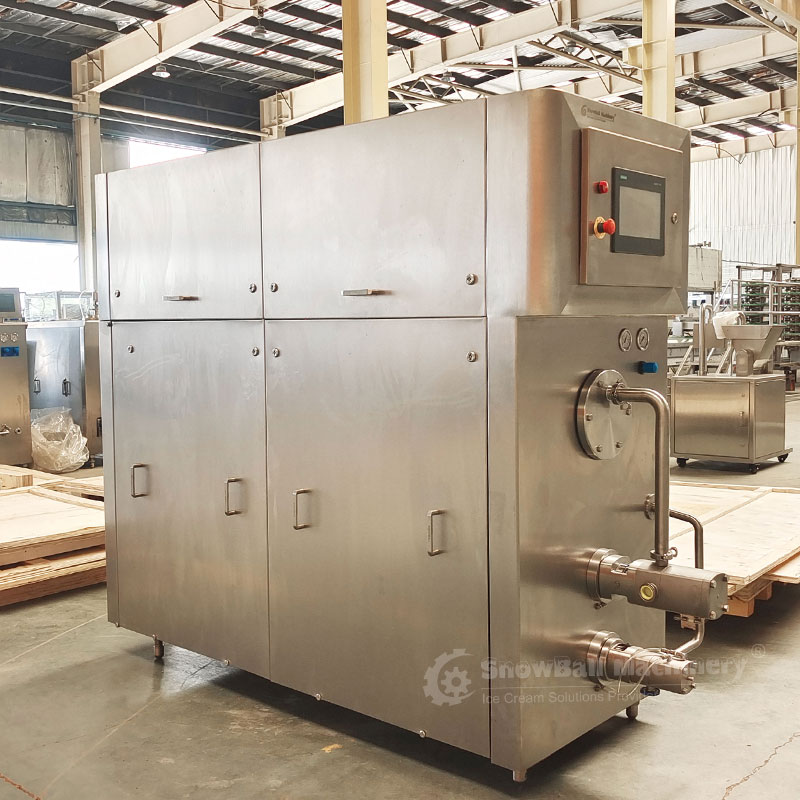
These three numbers need to be read together. Overrun describes the level of aeration in the frozen product, and 100 percent is the documented operating point for the Snowball continuous freezer range. The input temperature tells the buyer that the freezer is designed to receive chilled mix at around plus 5 degrees Celsius, which normally means the line should include proper ageing and chilling capacity upstream. Output temperature at around minus 5 degrees Celsius indicates the product leaves the freezer firm enough for filling, extruding or moulding.
If a supplier quotes only the capacity of an ice cream machine without mentioning overrun and input temperature, the number is incomplete and should not be used for line sizing.
2. Forming Line Output: Pieces Per Hour Instead of Liters Per Hour
Once the ice cream reaches the forming or filling stage, output is more often expressed in finished pieces per hour. Snowball documentation from operating projects includes an automatic ice cream cone filling line running at 10,000 to 15,000 pieces per hour and a stick ice cream production line running at 15,000 to 20,000 pieces per hour. In another documented case, an extruded magnum-style line was built with an output range of 5,000 to 8,000 pieces per hour.
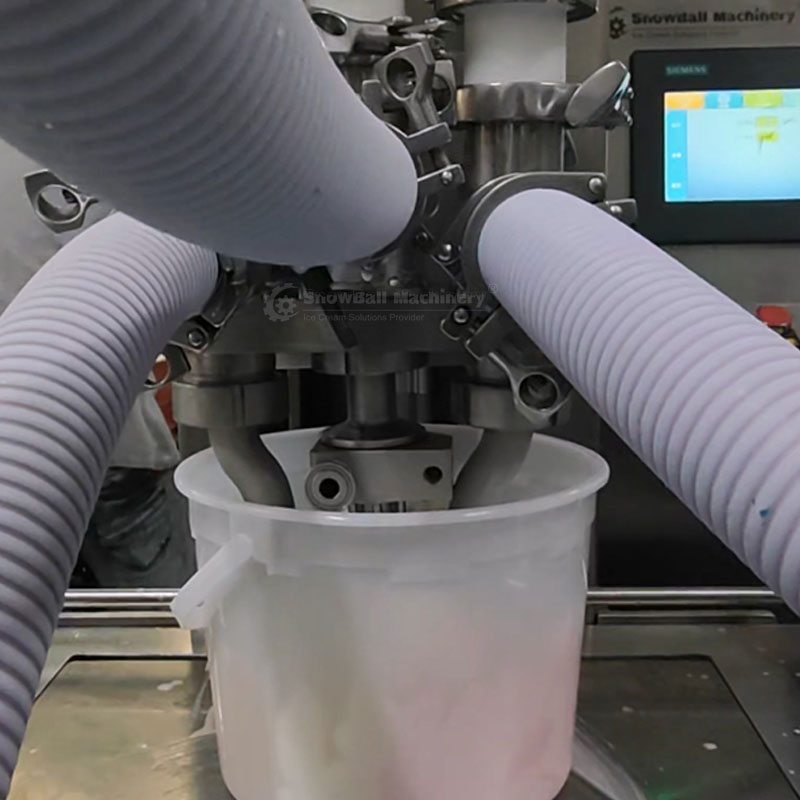
This distinction is important. The equipment range at Snowball also includes ice cream cup filling machines, cone filling machines, rotary filling machines, robot ice cream filling machines and linear filling machines. Cup and cone filling machines can complete processes such as automatic cup or cone dispensing, sauce topping, dry topping and lid dispensing, while a rotary filling machine can handle multiple container formats.
When a buyer asks how many pieces a line can produce, the answer should always reference the complete production configuration, not just the freezing capacity of a single unit.
3. Material Grade and Component Brands Are Part of the Specification
Material choice is as important as capacity. Snowball states that its equipment is built with high quality food grade stainless steel SS304 or SS316. The specification also lists internationally recognised component brands, including SIEMENS, Schneider Electric, FESTO, SMC, Danfoss, ABB, Bonfiglioli, igus, Copeland and Bitzer.
For a buyer, these details support two objectives. The first is food safety compliance, since surfaces that contact ice cream mix must be cleanable and corrosion resistant. The second is lifecycle cost, because a line built with reputable electrical and refrigeration components is easier to support when spare parts are needed.
4. Premix, Ageing, CIP and Hardening: The Hidden Machinery Scope
An industrial ice cream production line starts long before the freezer. Equipment in the mixing and processing group includes ice cream pro-mix machines, HTST pasteurizing systems, batch pasteurizing systems, homogenizers, ageing tanks, CIP cleaning systems, chocolate tanks and chiller systems. Snowball classifies these under its mixing machine range and offers them as part of a complete ice cream processing machine line.
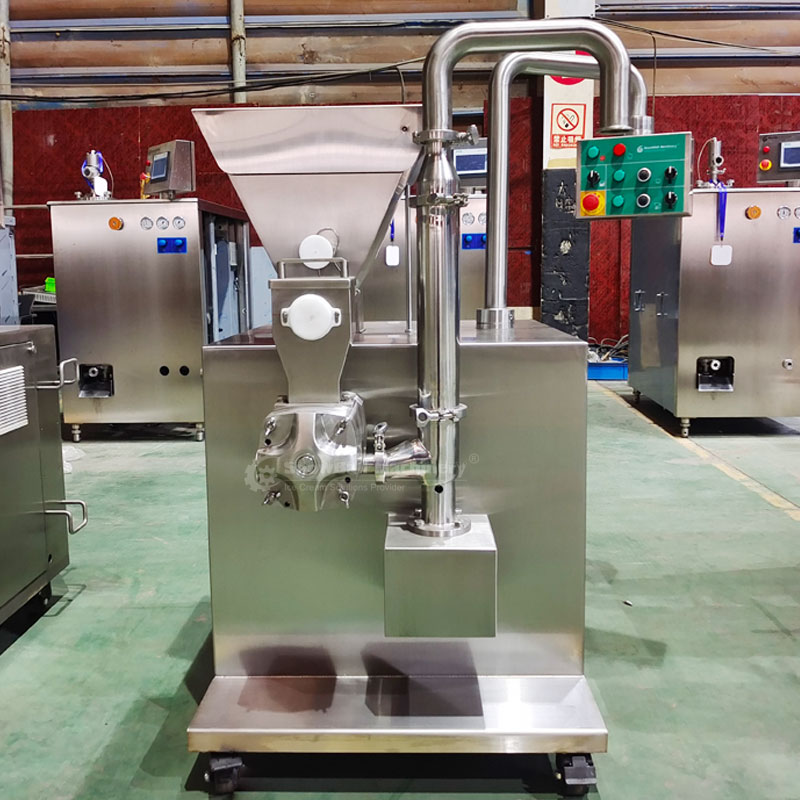
Specification mistakes often happen when buyers compare freezer prices but forget that pasteurizing, ageing, homogenizing, fruit feeding, hardening, packing and cold storage are all part of a turnkey ice cream machine solution. An ingredient feeder, for example, can be configured from 50 liters per hour up to 4,000 liters per hour depending on product requirements. This type of module changes both the specification and the total project cost.
5. Optional Units Change What the Machine Can Produce
Forming lines also have optional modules that define the product range. For stick ice cream machines, Snowball lists optional units such as ice water filling, a sucker unit, a stick inserter, chocolate coating stations, dry coating stations and popsicle moulds. For filling machines, optional units can include cup or cone dispensers, sauce topping, dry topping, lid dispensers and heat sealing stations.
These options matter during supplier evaluation because they determine whether the same base machine can later produce a filled chocolate-coated bar, a stick novelty or a decorated cup product. A buyer who wants future flexibility should ask exactly which optional stations are included in the quotation.
6. CE Certificates: What Buyers Should Verify on Each Machine
A CE certificate provides evidence that a machine has been assessed against the safety standards listed in the certificate. CE certification in Snowball's compliance files is machine-specific rather than a company-wide blanket statement.
For the ice cream continuous freezer, the CE certificate number is CE-4681-181125, issued by European Certification Services. The listed standards are EN ISO 12100:2010 and EN 60204-1:2018 +A1:2025. The molded stick ice cream machine carries two separate CE certificates: one from FQC STANDARD with certificate number FQC2506302 and one from CGS Test with certificate number CE-1654-01-111123. The Ingredient Feeder holds CE certificate CE-1724-01-121223, also issued by CGS Test.
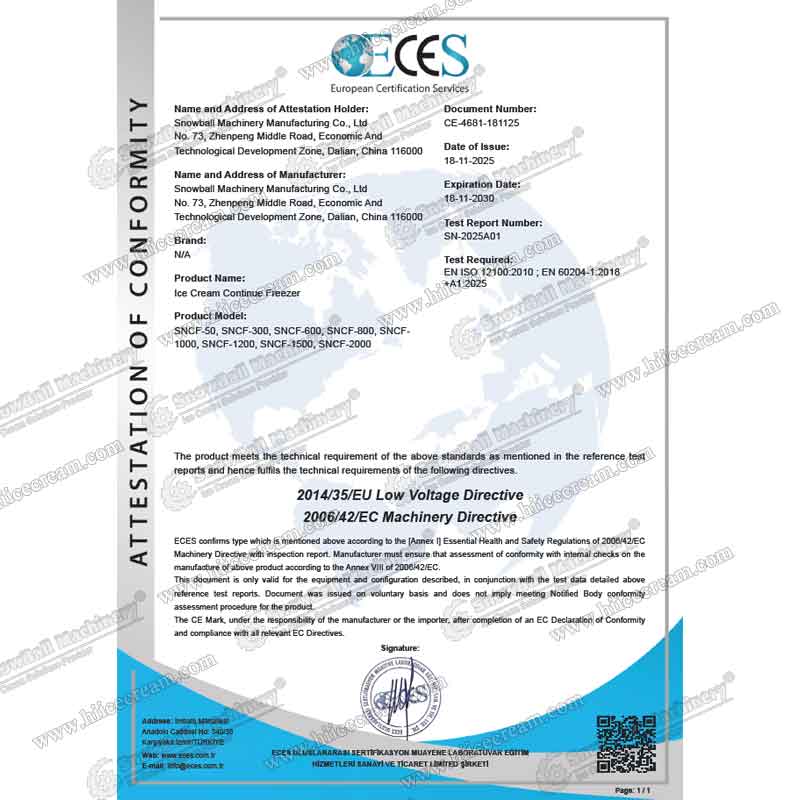
The buyer's checklist should include the equipment type named on the certificate, the certificate number, the issuing body, the applicable standards and the validity period. For commercial refrigerating appliances used in some markets, IEC 60335-2-89:2019 is an additional standard that may apply. Buyers should always confirm which standards their own target market requires.
Step-by-Step Breakdown: From Spec Sheet to Purchase Decision
Use a structured process when evaluating industrial ice cream machine suppliers. A specification comparison is only useful when every quotation is placed on the same technical basis.
- Define the product family. List the ice cream types planned for production: molded stick bars, popsicles, cups, cones, extruded logs, sandwiches, cakes or a combination of formats.
- Define the hourly output target. State whether the target is liters of ice cream per hour or finished pieces per hour. Ask the supplier to translate the same target into every stage of the line.
- Draw the process block diagram. A complete line normally includes premix processing and pasteurizing, homogenizing, ageing, continuous freezing, forming and filling, hardening, packing and cartoning. Snowball describes this as a turnkey service that starts with ice cream factory layout and includes the full line of machines from A to Z.
- Request a machine-specific quotation. Each machine should show its capacity basis, material grade, main component brands and optional stations. Snowball states that equipment is customized based on product design and hourly production capacity.
- Request CE documentation by model. Verify the certificate number, issuing body, scope, standards and validity. Ask the supplier to identify which CE certificate belongs to each machine model.
- Check the complete cost structure. The most important cost drivers are the number of processing stations, automation level, material specification and component brands. A low headline price for one freezer is not useful if the line configuration is incomplete.
Use Cases: The Same Specs in Different Production Environments
Specifications become easier to interpret when they are connected to real operating conditions.
New Manufacturer in a Hot, Humid Market
In one documented Snowball project, a newly established ice cream manufacturer started with a complete ice cream production line that included continuous freezers, an extrusion tunnel, packing machines and auxiliary equipment. The line was configured for 9,000 to 10,000 pieces per hour and designed to adapt to local power supply and operating conditions. The equipment remained stable for three years in a high-temperature and high-humidity environment, and the documented project notes that total line costs were lower than a comparable European-sourced line while maintaining the required output performance.
Upgrading a Line With Forty Years of Service History
Another Snowball project involved a long-established ice cream manufacturer that wanted to upgrade workstations on equipment that had been in service for 40 years. Snowball custom-designed workstations to match the customer existing line without full reconstruction. The documented result was a 40 percent increase in production efficiency, a 30 percent reduction in labor costs, and a 70 percent reduction in equipment upgrading costs compared with replacing the original brand workstations. The upgrade also used food grade 316 stainless steel materials to comply with production requirements in North American markets.
Turnkey Project for a Startup With Zero Factory Experience
A startup with no prior ice cream manufacturing experience used a Snowball turnkey whole-plant solution for small-to-medium scale production. The project included an extruded ice cream tunnel line for magnum-style bars at 5,000 to 8,000 pieces per hour and a family pack ice cream filling machine at 1,200 liters per hour, together with continuous freezers and associated equipment. Snowball provided plant layout planning, installation, commissioning and staff training. The project has reportedly operated stably for 11 years without major failures.
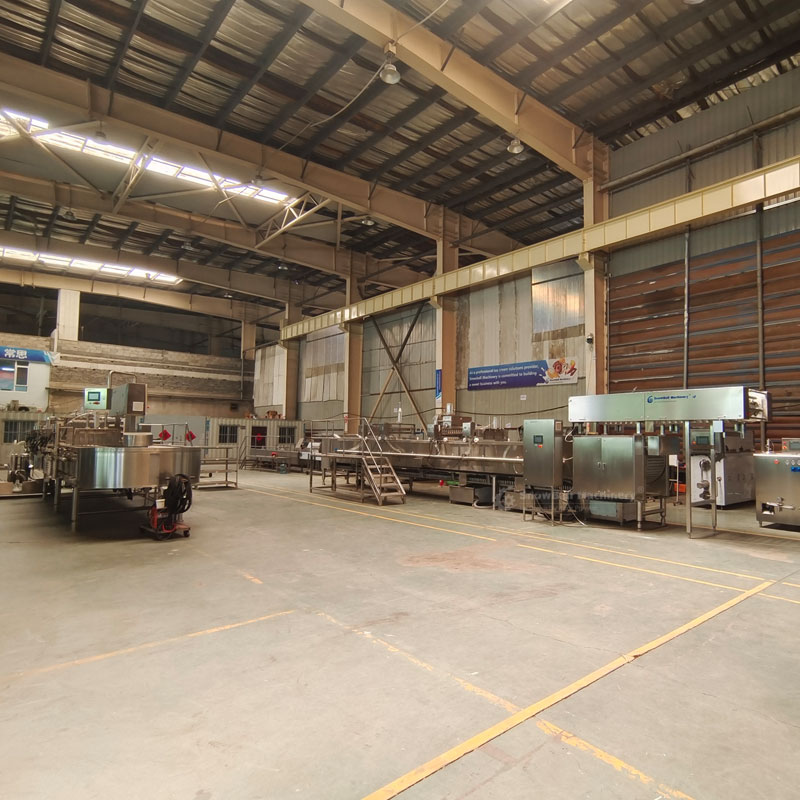
Comparison: Key Equipment Groups in an Ice Cream Factory
The following table compares the main machine groups supplied by Snowball Machinery, based on documented product specifications and project data. The table is intended to help buyers distinguish capacity units and line functions.
| Equipment group | Documented capacity parameters | Typical function in the line | Formats produced |
|---|---|---|---|
| Mixing and pasteurizing range | Customized by product design; includes HTST, batch pasteurizer, homogenizer, ageing tank, CIP | Premix preparation, heat treatment, homogenizing and ageing | Ice cream mix for cups, cones, bars and extruded products |
| Ice cream continuous freezer | 50-1,500 liters per hour; 100% overrun; input plus 5 degrees Celsius; output minus 5 degrees Celsius | Continuous freezing and aeration of ice cream mix | Frozen ice cream for filling, moulding, extruding or sandwich making |
| Molded stick ice cream machine | Customizable according to product design and mould configuration | Moulding, freezing, stick insertion, demoulding and optional chocolate coating | Molded sticks, popsicles, ice lollies, fruit bars, frozen novelties |
| Ice cream filling machine | Customizable; documented cone filling line output of 10,000-15,000 pieces per hour; family pack filling up to 1,200 liters per hour | Automatic or semi-automatic filling of containers | Cups, cones, pints, family packs, calippo-type and bulk ice cream |
| Extrusion and hardening line | Customizable; documented extruded bar line output of 5,000-8,000 pieces per hour | Extrusion, cutting and hardening of shaped products | Magnum-style bars, cake ice cream, sandwiches, logs, choco bars and stick novelties |
| Ingredient feeder | 50-4,000 liters per hour depending on configuration | Addition of solid inclusions such as fruit pieces, nuts, cookies and chocolate chips | Ice cream with particulates or swirls |
| Packing and associated machines | Customizable; part of complete line projects | Primary packing, cartoning and secondary packaging | Stick bars, cups, cones, packs and multi-packs |
Each row in this table represents a different piece of the line. A full quotation should state the capacity basis for every row, not only for the freezer.
Frequently Asked Questions About Ice Cream Machine Specs and CE Marks
1. What compliance documents should a supplier provide with an industrial ice cream machine?
The CE file should be machine-specific. Snowball's continuous freezer holds certificate CE-4681-181125 issued by European Certification Services; the molded stick ice cream machine holds certificates FQC2506302 from FQC STANDARD and CE-1654-01-111123 from CGS Test; the Ingredient Feeder holds certificate CE-1724-01-121223 from CGS Test. Buyers should check the machine scope, certificate number, issuing body, standards and validity. Commercial ice cream refrigerating appliances may also be regulated under IEC 60335-2-89:2019 in some markets.
2. How should I compare capacities when suppliers use different output units?
An industrial line has different capacity points. Freezers are measured in liters per hour, while forming and filling machines are usually measured in pieces per hour. Snowball lists its continuous freezers from 50 to 1,500 liters per hour at 100 percent overrun. Documented projects include automatic cone filling at 10,000 to 15,000 pieces per hour and a stick line at 15,000 to 20,000 pieces per hour. Ask every supplier to express capacity at the same line block before comparing prices.
3. Why do quotations with similar capacity differ so much in price?
Price follows technical scope and specifications. Snowball documents food grade stainless steel SS304 or SS316 construction and components from internationally known brands such as SIEMENS, Danfoss and Copeland. Optional stations such as stick insertion, chocolate coating and dry coating change the configuration. Comparing a single headline capacity number without the line scope can therefore be misleading.
4. Can a start-up use a small-capacity or trial line first?
Yes. Snowball states that its equipment is non-standard customized complete production equipment based on product design and hourly capacity. Documented applicable scenarios include ice cream workshops, small-scale ice cream factories and laboratory research and development lines, and one documented scenario covers small-capacity trial production for new ice cream products. Snowball also states an MOQ of one set.
5. What lead time should a buyer expect for custom ice cream machine equipment?
Snowball documents its lead time according to the specific equipment plan. The schedule depends on product type, line configuration and current production capacity, so an exact date is confirmed after the equipment plan is finalized. Snowball lists a monthly manufacturing capacity of about 100 sets. To get a project-specific lead time, send the target product range and hourly output to the company for a written plan.
Conclusion
Reading an ice cream machine specification sheet is a verification process, not an act of trust. Check the unit of capacity, check what the freezer can do with overrun and temperature, check which material grade and component brands are documented, and check that CE certificates are valid for the exact equipment model being quoted.
Snowball Machinery provides complete ice cream processing machine lines that include pasteurizing, ageing, continuous freezing, forming, filling, extrusion, ingredient feeding, packing and auxiliary support. Its documented product program is configured around the customer product design and hourly output target.
If you need a line specification matched to your products and target output, contact Snowball Machinery or download the company brochure for reference.
Download Snowball Machinery Brochure (PDF)Email: ice@snowballmachinery.com | icecreammachinemanufacturer.com
Have Questions or Need More Details?
Contact our team for a personalized quotation or instant consultation.
Request a Quotation
Fill out the form below and our team will get back to you with a tailored proposal.

LINE Direct Chat
Prefer to chat in real-time? Message us on LINE for instant assistance & quick answers.
- Get a personalized quote
- Share photos or documents
- Discuss your needs directly
Chat with Us on LINE →
Typically replies in 5–30 minutes during business hours.