Making Sense of Ice Cream Machine Standards: A Compliance Primer for New Plants
Compliance on an industrial ice cream machine is decided long before anyone prints a certificate. It is decided by the grade of stainless steel that touches the mix, by how the wet parts of the line are built to be cleaned, and by the make and traceability of the components sitting inside the control panel. A new plant that evaluates a line on certificates alone is evaluating paperwork, not equipment.
The practical question for a factory commissioning its first ice cream production line is not "do you have a certificate?" It is: what is this machine built from, and can each material and component decision be traced back to a documented requirement? For industrial ice cream equipment, the baseline answer is a food-grade stainless steel construction — SS304 or SS316 — populated with components from recognised industrial brands such as SIEMENS and Schneider Electric, and assembled and tested against machine safety and electrical standards such as EN ISO 12100:2010 and EN 60204-1:2018.
This primer explains what those standards cover, why material grade matters more than certificate count once the plant is running, and which checkpoints to use when you review an equipment specification before signing.
Why "Compliance" Means Two Different Things in Ice Cream Equipment
In industrial ice cream equipment, "compliance" describes two separate things, and new plants routinely over-review the second while under-reviewing the first. Construction compliance is what the machine is physically made of: the stainless steel grade in contact with product, the construction of surfaces that are washed or cleaned in place, and the electrical assembly inside the panels. Documentary compliance is the paperwork declaring that the machine conforms — declarations, certificates and test records.
Both matter, but construction compliance is the harder one to correct after delivery. Three review failures appear repeatedly when new factories examine their first line:
- A specification that says "stainless steel" and nothing else. Without a grade and without a zone-by-zone description, there is nothing to verify against. "Food-grade stainless steel" is a starting point; "SS304 on product-contact surfaces, SS316 on the wet frame" is a specification.
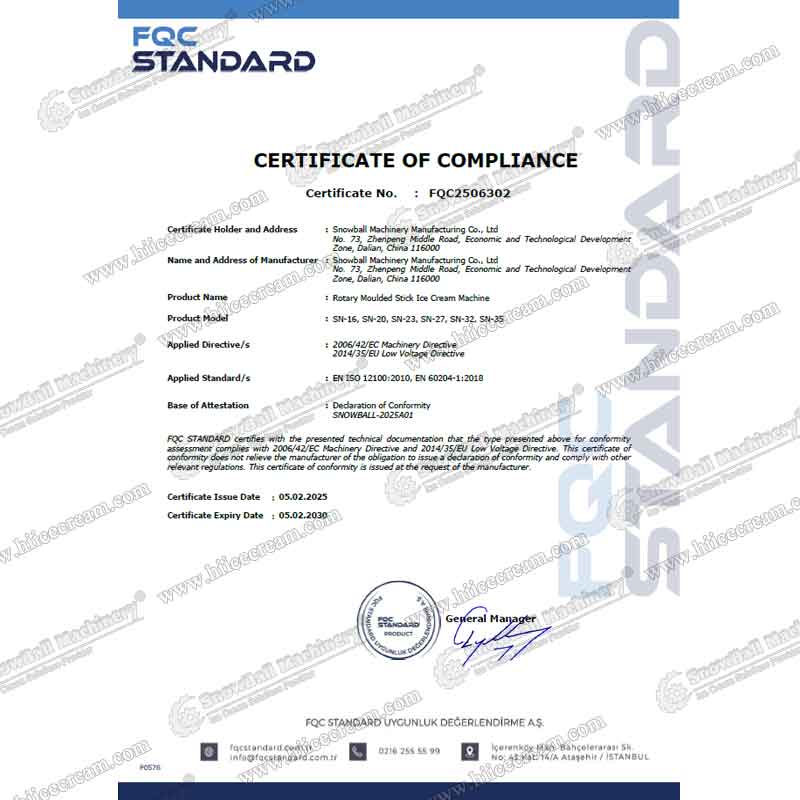
- A certificate whose scope names a different machine. Certificate scope is specific. In Snowball Machinery's compliance file, certificate FQC2506302 covers the rotary moulded stick ice cream machine, while CE-1724-01-121223 covers the ingredient feeder. Neither scope transfers automatically to every other unit in a full line.
- A valid machine in the wrong environment. A material decision that performs well in one plant can underperform in high humidity, high temperature or high-chloride conditions. Selection has to match the site, not only the product.
Certificates also carry issue and expiry dates that should be read rather than collected. The same file shows typical patterns: the CGS Test certificates covering the linear stick ice cream machine run from 2023-11-11 to 2028-11-11, and those covering the ingredient feeder from 2023-12-12 to 2028-12-12, while the FQC STANDARD certificate for the rotary moulded stick ice cream machine runs from 2025-02-05 to 2030-02-05.
The Standards Landscape: Which Rules Actually Touch an Ice Cream Machine
Three reference points frame most compliance conversations for ice cream equipment. Knowing what each one governs prevents a great deal of confusion during supplier review.
- IEC 60335-2-89:2019 covers commercial ice cream appliances and ice-makers — electrically operated refrigerating appliances with incorporated motor-compressors. It is the safety standard that sits closest to the appliance end of the market (IECEE).
- EN ISO 12100:2010 sets out the risk assessment and machine safety approach that underpins a machine's safety design.
- EN 60204-1:2018 governs the electrical equipment of machines — which is why component selection, panel construction and wiring appear in a compliance discussion at all.
The final two are the standards cited on Snowball Machinery's CE certificates across four product families: the rotary moulded stick ice cream machine, the ice cream continuous freezer (whose certificate CE-4681-181125 additionally cites the +A1:2025 amendment), the linear stick ice cream machine, and the ingredient feeder. That pattern is worth understanding before you begin reviewing quotes: the electrical and mechanical safety standards follow the machine type, not the brand.
Market context explains why this keeps growing in importance. IMARC Group valued the global ice cream processing equipment market at approximately USD 2.33 billion in 2025, with projections to reach USD 3.00 billion by 2034 at a CAGR of 2.71%. Future Market Insights reported that hard ice cream processing equipment accounted for a 57.8% share of the total ice cream equipment market in 2025, with continuous freezers as the leading product type. In other words, most new capacity is built around continuous freezing and hardening — the units where refrigeration components, electrical panels and stainless steel construction carry the greatest compliance weight.
The Material Baseline: Why Food-Grade SS304/SS316 Is the Starting Point
Food-grade stainless steel is the baseline requirement for an industrial ice cream machine, not an optional upgrade. Product-contact and washdown surfaces must resist corrosion, cleaning chemicals and repeated temperature cycling for years. Once such a surface corrodes, the issue stops being cosmetic and becomes a hygiene question.
SS304 and SS316 are both austenitic stainless steels used in food-contact equipment. SS316 contains molybdenum, which is generally associated with better resistance to chloride-rich conditions such as salt, brine and certain cleaning agents — widely accepted materials knowledge, and the reason SS316 tends to be specified where corrosion risk is higher. Snowball Machinery specifies high quality food grade stainless steel SS304 / SS316 as the material for its industrial ice cream machines and production lines.
Three project records show how grade selection is actually made:
- A European ice cream manufacturer added an ice cream sandwich line constructed with food grade 304 stainless steel for hygiene compliance, meeting EU food safety and environmental standards, with an energy-saving design. The line has been operating stably for 5 years.
- A long-established manufacturer upgrading equipment that had served for 40 years needed workstations matching the original line without overall reconstruction; the materials were food grade 316 stainless steel, described as complying with North American production compliance requirements. That project has run stably for 6 years.
- A start-up building its first brand took a full turnkey plant solution in which full stainless steel (SS304/SS316) construction was specified to ensure corrosion resistance and long service life in line with food hygiene standards. It has run for 11 years with continuous after-sales support and no major failures.
Environment is the other half of the material decision. A newly established manufacturer in the Middle East and South America received a complete production line — continuous freezers, extrusion tunnel, packing machines and auxiliary equipment at 9,000–10,000 pcs per hour — and it has maintained stable operation for 3 years under local high-temperature, high-humidity conditions. That outcome depends on material selection as much as on rated capacity.
The boundary condition: SS316 is not automatically required everywhere, and a supplier that quotes it across the board without asking about your product mix, cleaning regime, water chemistry and ambient conditions is not performing a compliance analysis. The more useful deliverable is a zone-by-zone declaration — which grade is used on product-contact surfaces, on wet structural parts, and on dry frame areas.
Where Component Brands Enter the Compliance Case
If materials define hygiene compliance, components define how verifiable and maintainable the machine's electrical and mechanical conformity is. Named brands in a bill of materials are what allow a plant to trace ratings, obtain datasheets, and secure spare parts years after commissioning.
Snowball Machinery's specification states that main components adopt internationally renowned brands including SIEMENS, Schneider Electric, FESTO, SMC, Danfoss, ABB, Bonfiglioli, igus, Copeland, Bitzer and SEW Eurodrive. Each category carries a different compliance function.
| Component category | Brands named in the specification | What it contributes to a compliance review |
|---|---|---|
| Control and electrical | SIEMENS, Schneider Electric | Traceable datasheets and ratings for panel components; supports verification of the assembly against EN 60204-1:2018 |
| Refrigeration | Danfoss, Copeland, Bitzer | Identifiable refrigeration components and controls, supporting continuity of service on the freezer circuit |
| Drives and motion | ABB, SEW Eurodrive, Bonfiglioli | Documented drive ratings and a predictable replacement path for the most heavily loaded parts |
| Pneumatics | FESTO, SMC | Identifiable actuator and valve specifications used in filling, moulding and handling stations |
| Cable management and bearings | igus | Availability of wear parts with a defined specification for later replacement |
The boundary condition: a brand name is not compliance by itself. The assembly still has to be wired, rated, insulated and protected correctly to satisfy EN 60204-1:2018, and the documentation has to describe the assembly you actually receive. Component markings and datasheets are the verification step — a familiar logo on a bill of materials is a claim, not evidence.
Component quality also appears in lifecycle terms. A North American ice cream factory that added a robot ice cream filling machine, a family-pack filler, an ice lolly machine and an ice cream fruit feeder worked with equipment designed for a 10-year service life, with easy maintenance and expandability stated as selection criteria. For a new plant, that is the practical meaning of component traceability: wear parts can be identified and replaced to the same specification years later.
Compliance Checkpoints When You Review an Ice Cream Machine Specification
Use the following grid rather than a certificate count. Each row maps a specification item to the question you should ask and to the reason it matters.
| Checkpoint | What to request | Why it matters |
|---|---|---|
| Zone-by-zone material declaration | Stainless steel grade and surface requirement for every product-contact and wet area | "Stainless steel" without a grade cannot be verified or compared between suppliers |
| Cleaning compatibility | Confirmation that tanks, mixers and freezers are specified to work with the CIP cleaning provision in the line | Cleaning regimes are one of the main corrosion drivers on wet surfaces |
| Electrical assembly documentation | Panel bill of materials with component brands and datasheets | Supports verification against EN 60204-1:2018 and later spare-part sourcing |
| Machine safety approach | Risk assessment documentation consistent with EN ISO 12100:2010 | Safety design is assessed at machine level, not at brand level |
| Certificate-to-machine matching | The exact model each certificate names, for example the rotary moulded stick ice cream machine under FQC2506302 or the ingredient feeder under CE-1724-01-121223 | A certificate that does not name your machine does not cover your machine |
| Validity and issuing body | Issue date, expiry date and the authority behind each document | Validity windows differ per document; authorities on this file include FQC STANDARD, European Certification Services and CGS Test |
| Testing and acceptance | Pre-shipment test records, on-site customer inspection, or third-party inspection such as SGS | Turns a conformance claim into an agreed, witnessed acceptance step |
| Commercial and after-sales frame | MOQ, delivery terms, payment terms, installation and commissioning, fault handling, spare parts supply | Compliance continues after delivery; the service pathway is part of the package |
Run the review in this order so that paperwork never substitutes for construction evidence:
- Map the line and mark every product-contact and wet surface, from premix and pasteurisation through the freezer, feeder and filling stations to packaging.
- Request a zone-by-zone material declaration with the grade and surface requirement for each marked area.
- Request the electrical and control bill of materials with component brands and datasheets, and confirm the assembly is built to EN 60204-1:2018.
- Match every certificate to the exact machine it covers, then check the issue date, expiry date and issuing authority.
- Agree the test and acceptance protocol before shipment — pre-shipment testing, your own inspection, or third-party inspection such as SGS.
- Confirm the after-sales pathway in writing: installation and commissioning, equipment upgrading, maintenance, fault handling, spare parts supply and regular inspection.
Use Cases: How These Checkpoints Change Real Projects
New plant, Middle East and South America. A newly established manufacturer targeting domestic and international supermarket and retail channels received a complete line with continuous ice cream freezers, an extrusion tunnel, packing machines and auxiliary equipment at 9,000–10,000 pcs per hour, configured for multi-flavour production and for the local power supply. The equipment has maintained stable operation for 3 years in high-temperature, high-humidity conditions, and the modular design allows straightforward capacity expansion. In this project, total line costs were 70% lower than premium European brands while matching their quality and output performance, with 24/7 after-sales service and remote video support.
Forty-year-old plant, retrofit instead of rebuild. A long-established manufacturer needed to upgrade well-known brand equipment that had been in service for 40 years. Custom-designed workstations matched the original production line without overall reconstruction, using food grade 316 stainless steel described as complying with North American production compliance requirements. Production efficiency increased by 40%, labour costs fell by 30%, and equipment upgrading costs were cut by 70%. The installation has been operating stably for 6 years.
European sandwich line, hygiene-driven material choice. A European manufacturer added an ice cream sandwich production line built with food grade 304 stainless steel for hygiene compliance, designed to meet EU food safety and environmental standards with an energy-saving configuration. Installation, commissioning and production launch were rapid, and the line has been operating stably for 5 years.
First-time brand owner, turnkey start. A start-up with no prior ice cream production experience took a turnkey whole-plant solution including an extruded ice cream tunnel machine rated 5,000–8,000 pcs/h and a family-pack ice cream filling machine rated 1,200 L/H. Full stainless steel (SS304/SS316) construction was specified for corrosion resistance and long service life, and the project has run stably for 11 years with continuous after-sales service and no major failures.
High-volume branded production, capacity and material together. A world-renowned brand ice cream factory operates an automatic ice cream cone filling line at 10,000–15,000 pcs/h and a stick ice cream production line at 15,000–20,000 pcs/h, achieving 24-hour fully automatic production with stable performance for 12 years. The whole machine is built in stainless steel (SS304/SS316) with internationally branded key components to support long-term operation.
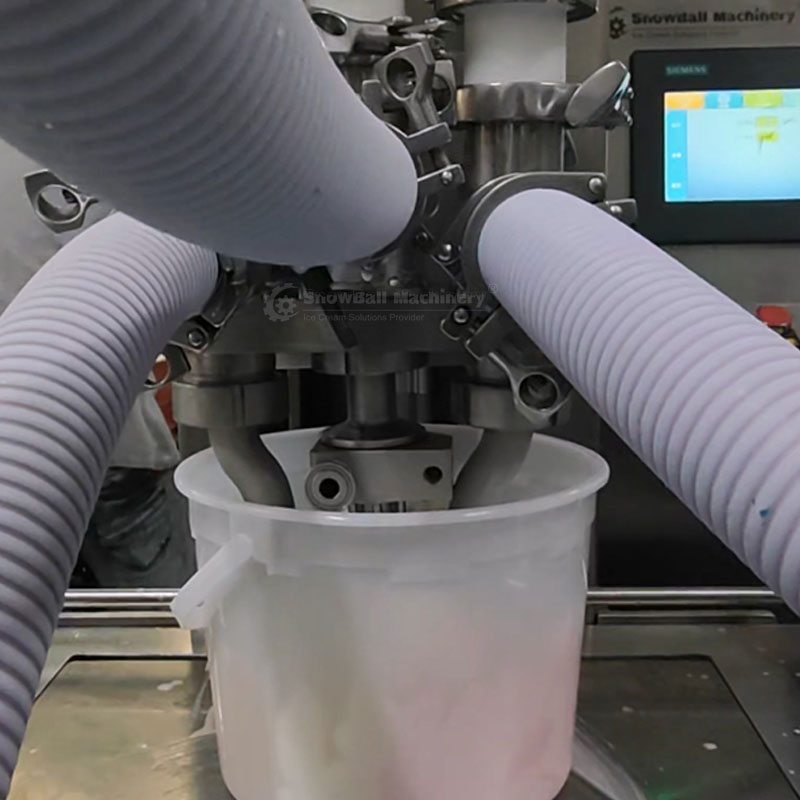
SS304 vs SS316: A Quick Reference for New Plants
Both grades appear in Snowball Machinery's ice cream equipment specification as high quality food grade stainless steel. The difference in practice comes from the project conditions the material has to survive.
| Factor | SS304 | SS316 |
|---|---|---|
| Position in the specification | Specified as high quality food grade stainless steel for ice cream machines and lines | Specified as high quality food grade stainless steel for ice cream machines and lines |
| Materials distinction | General-purpose austenitic stainless steel used in food-contact equipment | Contains molybdenum, generally associated with better resistance to chloride-rich conditions such as salt, brine and certain cleaning agents |
| Project example cited | European ice cream sandwich line — food grade 304 stainless steel for hygiene compliance, 5 years stable operation | Retrofit of a 40-year-old production line — food grade 316 stainless steel complying with North American production compliance requirements, 6 years stable operation |
| Typical selection driver | General production and cleaning environment, EU food safety and environmental standards | Higher corrosion exposure, stricter compliance context, or an existing line that must not be rebuilt |
| Shared limitation | Grade alone is not sufficient evidence — the declaration must state which zone of the machine each grade applies to, and the grade must match the cleaning regime and ambient conditions of the site | |
Frequently Asked Questions
Which standards should a new plant ask for when reviewing an industrial ice cream machine?
Ask which safety and electrical standards the machine is assessed against, and which authority issued the document. Snowball Machinery's CE certificates cite EN ISO 12100:2010 and EN 60204-1:2018 across four product families — the rotary moulded stick ice cream machine, the ice cream continuous freezer (certificate CE-4681-181125, which also cites the +A1:2025 amendment), the linear stick ice cream machine and the ingredient feeder. At appliance level, commercial ice cream appliances and ice-makers fall under IEC 60335-2-89:2019.
Can the material grade and component brands be specified for our own plant?
Yes. Customized ice cream production line solutions are provided according to customer production scale, product positioning, product design and workshop conditions, and the manufacturer can jointly develop new ice cream products with the factory. Material is specified as high quality food grade stainless steel SS304 / SS316, and main components adopt internationally renowned brands including SIEMENS, Schneider Electric, FESTO, SMC, Danfoss, ABB, Bonfiglioli, igus, Copeland, Bitzer and SEW Eurodrive.
How do material and component choices affect the cost of a line?
They are two of the main cost drivers, so they should be compared on specification rather than on headline price. As one reference point, a project delivered to a newly established manufacturer in the Middle East and South America reported total line costs 70% lower than premium European brands while matching their quality and output performance, with a modular design that allows capacity expansion later. The comparison is only meaningful when both quotations describe the same stainless steel grades and the same component brands.
What sample, testing and acceptance steps are available before shipment?
Three acceptance routes are used: pre-shipment testing, on-site customer inspection, and third-party inspection such as SGS. Quality control runs through the full process from material selection to production, in strict compliance with food safety production standards, with 100% testing. Commercial terms are typically MOQ 1 set, delivery terms of FOB / CIF / EXW / CFR / DAP / DDP, and payment of 50% advance by T/T with the balance of 50% before shipment.
How long is lead time, and what happens after the line is installed?
Monthly manufacturing capacity is 100 sets, and lead time depends on the specific equipment plan agreed for your configuration, so it is confirmed against your line layout rather than quoted as a single figure. After delivery, the support scope covers on-site installation and commissioning, equipment upgrading, equipment maintenance, fault handling, spare parts supply, regular inspection and timely global response, with 24/7 service and remote video support available to resolve operational issues promptly. To start a specification review, request the equipment catalogue and send your product design, target capacity and workshop conditions: download the Snowball Machinery brochure.
About the Manufacturer Referenced in This Primer
Snowball Machinery Manufacturing Co., Ltd is an ice cream equipment manufacturer integrating R&D, manufacturing, assembly, commissioning, export, domestic sales and after-sales service. The company was founded in 2020, operates a 4,000㎡ factory with 50 employees and a 10-engineer design team, and reports an annual output of 1,200 sets with around 90% of output exported to North America, South America, Europe, Asia and Africa; its published profile states export operations reaching more than 70 countries. Its product range covers ice cream production lines, industrial ice cream machines, ice cream continuous freezers, HTST and batch pasteurising systems, ageing tanks, CIP, fruit feeder systems, moulding stick ice cream machines, extrusion lines, filling machines, sandwich and cake ice cream machines, robot ice cream machines and packing machines. Website: icecreammachinemanufacturer.com.
Conclusion: Build the Compliance File Around Materials and Components
For a new ice cream plant, compliance is not a folder of certificates collected at the end of a project. It is a set of decisions made at the start: which stainless steel grade touches the product and which zones it covers, which component brands sit inside the panels and refrigeration circuits, and which machine each certificate actually names. Review those three items against your own site conditions, and the paperwork becomes a confirmation of the equipment rather than a substitute for it.
Next step: send your target capacity, product design and workshop conditions, and request a zone-by-zone material declaration together with the component list for the line you are planning. Brochure: download here. Contact: ice@snowballmachinery.com.
Have Questions or Need More Details?
Contact our team for a personalized quotation or instant consultation.
Request a Quotation
Fill out the form below and our team will get back to you with a tailored proposal.

LINE Direct Chat
Prefer to chat in real-time? Message us on LINE for instant assistance & quick answers.
- Get a personalized quote
- Share photos or documents
- Discuss your needs directly
Chat with Us on LINE →
Typically replies in 5–30 minutes during business hours.