Scaling Your Ice Cream Production: Choosing a Partner Who Grows With You
Building an Ice Cream Production Line That Scales With Your Factory
Short answer: To scale an ice cream factory reliably, you need more than a single ice cream machine — you need an equipment partner that can supply a complete, modular production line; support future capacity and product changes; and back the installation with long-term service. This article explains what that partnership looks like at the decision and execution stage, the equipment modules involved, how to verify a supplier's long-term readiness, and what to check before you commit.
Most factory owners are no longer deciding whether to buy a single freezer. They are deciding which turnkey ice cream machine solution can start production on time, keep quality consistent, adapt to new products such as stick bars, extrusion items, cups, cones and sandwiches, and expand as demand grows. That is a partnership decision, not a commodity purchase.
Why the Long-Term Equipment Partnership Matters in Ice Cream Production
Definition. A long-term ice cream equipment partnership is an arrangement in which the supplier provides not only the hardware but also factory layout advice, process integration, installation, staff training, spare parts support, and upgrade paths for the life of the production line. For a factory that expects to keep producing for years, the relationship often matters more than the individual machine specifications.
The ice cream production equipment market is substantial and expanding. The global ice cream processing equipment market was valued at roughly USD 2.33 billion in 2025, with projections to reach USD 3.00 billion by 2034 at a CAGR of 2.71% (IMARC Group). The ice cream moulding production line segment was valued at USD 1.2 billion in 2024 and is expected to reach USD 2.5 billion by 2034 (Reports and Data). These figures indicate a mature category with a long replacement and upgrade cycle — a reason to evaluate suppliers on durability and support, not only on the purchase price.
Several trends make the choice more consequential:
- Buyers increasingly ask for one supplier for the complete line from mixing to packaging, rather than integrating equipment from many vendors.
- Factories changing product lines — adding stick ice cream, extruded novelties, sandwiches, cakes or filled cups — benefit from a partner who can reconfigure or extend the line.
- Upgrading existing equipment, particularly from well-known brands, can be faster and less costly when the supplier has retrofitting experience.
Decision point: If your project involves a new factory, a new product category, or a target export market, confirm early whether the supplier has the engineering and service capacity to support the full line from day one and during future expansions.
What a Complete Scalable Ice Cream Processing Line Includes
A complete production line is a series of interconnected modules that turn raw mix ingredients into finished, packaged ice cream products. A partner focused on long-term operation should be able to design and deliver the whole chain.
1. Mix Preparation and Pasteurization
Definition. The mix preparation stage converts raw ingredients (milk, cream, sugar, stabilizers, emulsifiers, water) into a homogeneous, pasteurized liquid base that is ready for freezing.
Relevant equipment categories include an ice cream pro-mix machine, HTST pasteurizing system, ice cream batch pasteurizing system, homogenizer, high-shear mixer, chocolate tank and holding tank. These units determine the consistency, food safety and shelf life of the finished product.
2. Ageing and Holding
After pasteurization, the mix is held in an ice cream ageing tank (ageing vat) at controlled temperature to allow the proteins and stabilizers to hydrate fully. Proper ageing improves overrun stability and texture. The line can also include a chilled water or water-cooled chiller system for continuous process cooling.
3. Continuous Freezing and Flavouring
Definition. An ice cream continuous freezer aerates and freezes the mix under controlled shear to produce the finished soft-frozen ice cream at the desired overrun and consistency.
Continuous freezers are available in capacities such as 50, 300, 600, 1200 and 1500 liters per hour, with a rated overrun of 100%, input material temperature of +5°C and output temperature of -5°C (Snowball Machinery). The leading product type in the hard-ice-cream equipment segment is continuous freezers, which also held a dominant 57.8% segment share in 2025 (Future Market Insights).
Inclusions such as fruit pieces, nuts, cookies or swirls are added through an ice cream ingredient feeder (also called fruit feeder or solid inclusions feeder), with capacities customizable from 50 to 4000 liters per hour depending on the production target. Additional units such as a ripple pump can create layered or variegated effects.
4. Forming, Filling, Extrusion and Moulding
This is the stage where the product takes physical shape. It can include several distinct lines:
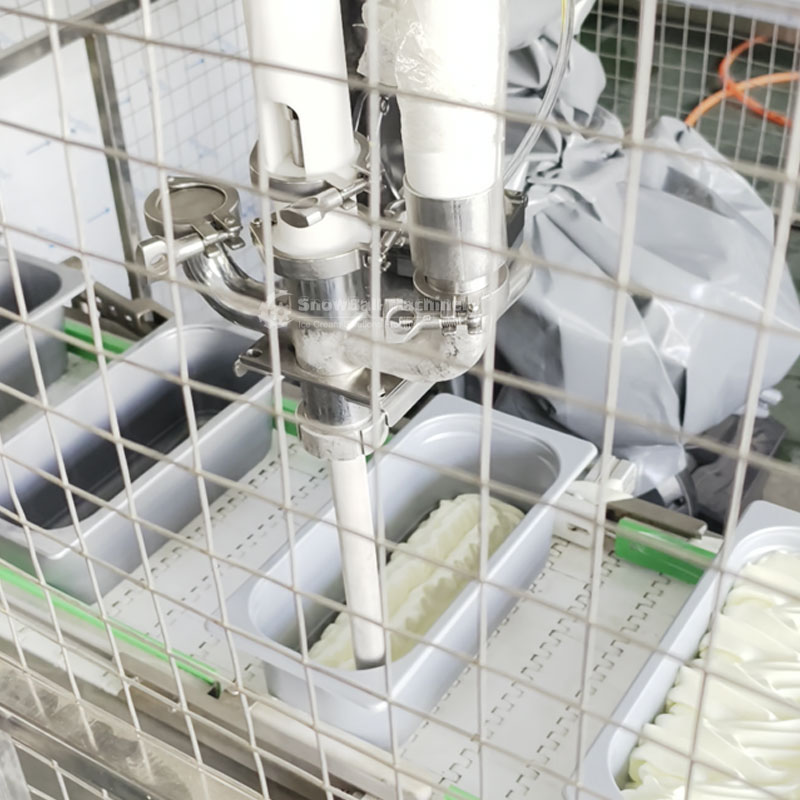
- Ice cream cup filling machine — fills cups, pints and family packs automatically; can be a linear, rotary or robot filling configuration.
- Automatic cone ice cream filling machine — handles cone products such as Cornetto-type items and can include chocolate or sauce topping, dry topping, lid dispensing and heat sealing units.
- Molded stick ice cream machine — produces popsicles, ice lollies, fruit bars, water ice and other molded stick novelties. Product-specific options include a stick inserter, chocolate coating station and dry coating station.
- Extrusion ice cream machine — produces cakes, sandwiches, waves, balls, bonbons, choco bars, Eskimo bars and magnum-type stick products.
- Ice cream sandwich making machine — automatically forms and cuts sandwich products and often includes wrapping or packaging functions.
- Robot ice cream machine — automated robotic filling and decorating cells for cups, cones and complex novelty products.
5. Hardening and Packaging
Finished products pass through a hardening tunnel or cold storage room to reach the core temperature appropriate for storage. At this stage, production lines also include an ice cream packing machine, secondary packaging/cartoning machine, and carton packaging equipment to prepare products for distribution.
| Stage | Typical Equipment | Function |
|---|---|---|
| Mix preparation | Ice cream pro-mix machine, HTST, batch pasteurizer, homogenizer | Blend and pasteurize raw ingredients |
| Ageing | Ice cream ageing tank, chilled water system | Hydrate stabilizers and stabilize mix temperature |
| Freezing | Ice cream continuous freezer (50–1500 L/H) | Aerate and freeze mix to -5°C at up to 100% overrun |
| Inclusions | Ice cream ingredient feeder, fruit feeder, ripple pump | Add fruit, nuts, cookies or swirl effects |
| Forming | Molded stick machine, extrusion line, sandwich machine, cup/cone filler, robot filler | Shape the finished novelty product |
| Hardening & packing | Hardening tunnel, cold storage, packing machine, cartoner | Freeze to storage temperature and package for sale |
Assessing the Supplier's Ability to Execute and Grow With You
At the Decision and Execution stage, the central question is not just whether the equipment can run — it is whether the supplier can deliver, install, commission and service the line while remaining responsive as your production plan changes.
Delivery and Commissioning Readiness
Delayed delivery and slow installation can directly delay your production launch. A supplier with standardized delivery procedures and modular production can shorten the cycle, communicate progress in real time, and prepare compliance and customs documentation in advance for overseas customers.
Snowball Machinery reports a monthly production capacity of 100 sets, a minimum order quantity of 1 set, and production lead time determined according to the specific equipment plan. For overseas buyers, the supplier supports FOB, CIF, EXW, CFR, DAP and DDP delivery terms, and offers pre-shipment testing, on-site customer inspection and third-party inspection (SGS). This kind of documented arrangement reduces uncertainty at the execution stage.
Installation, Training and After-Sales Support
For a production line to operate from the first week, the buyer needs more than the machine itself. The supplier should provide multi-language operation manuals and training videos, video-call guidance, remote assistance functionality, and a responsive service structure.
Reference points to verify:
- Dedicated customer service groups with 24/7 response.
- Remote assistance functions built into the machines.
- Overseas after-sales outlets or partner service providers.
- On-site support arrangements for special issues.
- Clear time limits for production, logistics and installation.
Adaptation and Upgrade Pathway
One of the most overlooked risks is the cost of changing the line later. If the equipment cannot adapt to capacity expansion or new product iterations, renovation costs can become substantial. A partner that uses modular, expandable designs can support later upgrades, new flavors and new specifications without complete equipment replacement. Ask the supplier how they handle the following:
- Pre-sales evaluation of your production demand and capacity plan.
- Customized equipment design with reserved upgrade interfaces.
- Technical support for equipment retrofitting and upgrades.
- Regular follow-up visits and product iteration support.
- Retrofit or upgrade experience with well-known brand equipment.
Quality and Food Safety Compliance
Equipment that fails to deliver accurate filling, consistent overrun, correct swirl patterns or reliable hygiene can cause product rejects or regulatory problems. On the buyer side, look for a supplier that uses food-grade stainless steel 304/316 throughout the equipment, applies high-precision sensors or servo systems where control matters, and conducts multiple quality inspection checkpoints during production.
Relevant international references include the safety standard IEC 60335-2-89:2019 for commercial refrigerating appliances, and the common industry references of ISO 9001, FDA, CE and FSC cited by suppliers in the ice cream machinery sector. A rigorous supplier should also run trial operation before delivery — for example, material-loaded trial operation of continuous freezers — to simulate the customer's actual production environment and identify potential faults before shipping.
Execution tip: Ask for the evidence: material certificates, pre-delivery test reports, photos or records of material-loaded trial runs, compliance certificates for the target market, and a written installation and commissioning plan with named contacts.
Comparing the Long-Term Partnership Model: Key Factors
The following table summarizes a framework for comparing industrial ice cream machine manufacturers at the project execution and long-term partnership stage. The criteria are based on the supplier's documented capabilities and on the risks that commonly arise in ice cream factory projects.
| Comparison Criterion | What to verify with the supplier | Why it matters for a long-term project |
|---|---|---|
| Full-line capability | Mixing, HTST, ageing, freezing, filling, moulding, extrusion, packing | Reduces integration risk and simplifies procurement |
| Customization approach | Equipment customized to product design and hourly capacity | Ensures the line fits the exact product range |
| Delivery and lead time | Monthly capacity, MOQ, production schedule, incoterms | Protects the factory launch timeline |
| Commissioning and training | Installation team, multi-language manuals, training videos, remote assistance | Reduces ramp-up time and operating errors |
| After-sales response | 24/7 service group, overseas service partners, on-site support | Minimizes downtime risk in continuous production |
| Upgrade pathway | Modular design, reserved interfaces, retrofit support | Controls the cost of product or capacity changes |
| Quality and compliance | SS304/316, ISO 9001, FDA, CE, FSC references; pre-shipment testing | Protects product quality and market access |
| Long-term reliability | Expected equipment service life, stable operation record, reference performance | Reduces lifecycle replacement cost |
Snowball Machinery describes its own positioning as a supplier that provides a full line of ice cream machines from A to Z and supports the upgrading and retrofitting of well-known brand equipment. Its stated performance claims include European-grade quality, total costs 40–70% lower than internationally renowned brands, 60–80% shorter equipment delivery time than major well-known brands, 90% lower maintenance costs from stable operation, and 20% higher energy efficiency (Snowball Machinery). Claims of this type should be verified directly in writing before the purchase decision; the framework above shows you where to ask for evidence.
Using a Turnkey Ice Cream Machine Solution for Maintenance and Operational Stability
Definition. A turnkey ice cream machine solution is one in which the supplier designs, manufactures, delivers, installs and commissions the line so the buyer can begin production with far less integration work.
For factories with limited ice cream industry knowledge, the turnkey model includes early consulting to define products and capacity; for experienced producers, it is a way to procure all quality equipment without complex multi-vendor sourcing.
Operational stability is improved by choosing core components from internationally recognized brands such as SIEMENS, Schneider Electric, FESTO, SMC, Danfoss, ABB, Bonfiglioli, igus, Copeland, Bitzer, and SEW Eurodrive. At the execution stage, also confirm that the equipment includes an intelligent monitoring system with real-time early warning for abnormal operation, and that the design addresses climate conditions such as high temperature and high humidity if those apply to your factory location.
Use Cases: How a Long-Term Partner Supports Different Production Goals
New factory with limited in-house ice cream knowledge
A first-time ice cream producer, such as a food company diversifying into frozen desserts, often needs one partner to design the line, specify the equipment, commission it, and train the operators. The turnkey approach reduces the risk of selecting wrong components. The buyer should look for a custom solution built around the product design and target hourly capacity, with on-site training and clear documentation.
Existing ice cream producer adding stick bars and novelties
A dairy or gelato producer wanting to add molded stick products needs a different machine architecture: a moulding line with stick inserter, extraction, chocolate coating and dry coating capabilities. Because these lines are non-standard and customized, the supplier's engineering depth is critical. The buyer should ask how the new line will connect to the existing mix preparation and ageing capacity.
Producing extruded products: sandwiches, cakes, bonbons and choco bars
Extrusion technology is especially demanding because the product must be extruded at low temperature, hardened, cut, coated or decorated, and handled without melting or distortion. Suppliers with dedicated extrusion line experience can help avoid the delays that come from trial and error on the factory floor.
Cup, cone and family-pack filling
For high-volume cup and cone production, the filling line can include a cup or cone dispenser, filler, chocolate or sauce sprayer, topping units, lid dispenser, and heat sealing. A robot ice cream filling machine can handle complex decorations that would otherwise require substantial manual labor. Because filling accuracy directly affects product weight and regulatory compliance, high-precision sensors and servo controls are important.
Cost and Reliability Considerations in a Long-Term Partnership
Total cost perspective
When comparing suppliers, consider the total cost of ownership rather than the initial quote. This includes the purchase price, delivery, installation, commissioning, training, spare parts, energy consumption, maintenance, and the future cost of reconfiguration or expansion. A lower-priced machine may look attractive until an inefficient freezer, repeated downtime, or an expensive retrofit raises the cost over 5–10 years.
Service life and operating reliability
Stable operation is directly connected to lifetime cost. Snowball Machinery states that its equipment provides stable operation for 12 years while meeting high quality requirements of branded ice cream manufacturers, and that equipment service life is 6–9 times longer than comparable priced alternatives (Snowball Machinery). Qualified claims of this kind should be supported by the supplier with reference cases, component quality documentation, and maintenance recommendations.
Energy and maintenance efficiency
Energy efficiency affects margins on every batch produced. The supplier claims 20% higher energy efficiency and 90% lower maintenance costs resulting from stable operation (Snowball Machinery). When assessing these claims, ask for component brands, insulation details, compressor efficiency, control logic, and any measured references that support the figures.
Step-by-Step: How to Execute an Ice Cream Line Purchase With a Long-Term Partner
- Define the product range and target capacity. List the products you will make today and may add within 1–3 years: stick bars, cones, cups, sandwiches, cakes, bulk or family packs.
- Decide the line architecture. Determine which forming technology — molding, extrusion, filling, or a combination — is required for the product list. Confirm hourly capacity targets and shift patterns.
- Prepare the factory requirements. Check available floor space, utilities, water supply, refrigeration capacity, drainage, and environmental conditions such as temperature and humidity.
- Request a customized line proposal. A qualified supplier should ask about the product formula, packaging format, capacity, and target export markets before drawing the line.
- Verify compliance and quality documentation. Request the certificates relevant to your market (for example, CE, FDA or other food machinery compliance), materials certifications for SS304/316, and a description of the quality inspection process.
- Confirm installation and commissioning procedures. Ask how the supplier prepares multi-language manuals, training videos, remote assistance, and site installation teams.
- Check the upgrade and retrofit policy. Ask whether the equipment uses modular design and reserved interfaces for capacity expansion or product changes.
- Clarify commercial terms. Confirm MOQ, incoterms, payment schedule, pre-shipment testing, and the lead time for your specific line.
- Agree on after-sales support. Write down the response windows, service contacts, spare parts availability, and the process for remote troubleshooting and on-site visits.
Risks and How to Mitigate Them
| Risk | Mitigation Measures to Discuss With the Supplier |
|---|---|
| Product quality failures during production | High-precision sensors and servo controls, food-grade SS304/316, multiple quality inspection checkpoints, pre-delivery testing |
| Equipment operation failures or shutdown | Core components from internationally recognized brands, modular design, intelligent monitoring, trial run before delivery |
| Delivery and after-sales delays | Standardized delivery procedures, clear time limits, 24/7 customer service, remote assistance, overseas service partners |
| Difficulty adapting to capacity or product changes | Modular design, upgrade interfaces, customized engineering, documented upgrade support |
| Food safety compliance gaps | Hygienic stainless steel design, compliance documentation and certificates, pre-shipment inspection, third-party inspection option |
Choosing a Supplier for the Long Term: Supplier Evaluation Checklist
- Full-line scope: Can the supplier provide the complete line from mix preparation to packing, not just isolated machines?
- Engineering capacity: Does the supplier have a mechanical design team that can customize equipment to the product design and hourly capacity?
- Manufacturing capacity: What is the monthly production capacity? Does it fit your delivery window?
- Quality system: Does the supplier conduct incoming component inspections, food-grade checks and pre-delivery trial operation?
- Reference market experience: Has the supplier exported to your region? What documentation exists for the target market's compliance environment?
- Service network: Is after-sales support managed through dedicated teams, overseas outlets or partner service providers?
- Remote support tools: Does the equipment support remote assistance for diagnostics and commissioning?
- Upgrade support: Can the supplier retrofit existing equipment, including well-known brand lines, without full replacement?
- Commercial flexibility: Are MOQ of 1 set and flexible incoterms available for your project scale?
FAQ
What should I check about compliance before purchasing an ice cream production line?
Check whether the supplier documents compliance with the standards required by your target market. Common international references for food processing equipment include ISO 9001 quality management and IEC 60335-2-89:2019, which covers commercial refrigerating appliances with motor-compressors. In the ice cream machinery sector, suppliers commonly also reference FDA, CE and FSC in their compliance documentation. Ask the supplier to confirm which compliance or certification references will apply to your line and to provide the relevant certificates before shipment. Snowball Machinery states that it conducts food-grade and precision testing on each piece of equipment before delivery and issues qualification certificates.
What equipment is needed to make molded stick ice cream, popsicles and ice lollies?
Molded stick ice cream, popsicles and ice lollies are produced on a molded stick ice cream machine (also called a popsicle machine or ice lolly machine). The line typically includes the moulding machine itself plus optional units such as an ice water filler, stick inserter, chocolate coating station and dry coating station. The molded stick machine is customized based on the product design and hourly production capacity, so the supplier should be able to adapt the number of lanes, mould shapes and cycle speed to the specific product range.
What is the difference between an extrusion ice cream machine and a molded stick machine?
A molded stick ice cream machine forms product inside individual moulds that are immersed in a refrigerated brine or equivalent system; the product takes the shape of the mould and a stick is inserted before extraction. An extrusion ice cream machine extrudes soft-frozen ice cream through a nozzle in a continuous stream; the extruded product is then cut, hardened, coated or decorated and may or may not contain a stick. Extrusion lines are commonly used for cake ice cream, sandwich ice cream, wave ice cream, bonbon products, chocolate bars, Eskimo bars and magnum-type products. They can also produce stick items but the forming logic is different from moulding. A full factory may require both technologies to cover a diverse product portfolio.
What is the usual minimum order quantity and lead time for a complete ice cream line?
The minimum order quantity for a complete line can be as low as 1 set, depending on the supplier. Production lead time is not a fixed number; it is determined according to the specific equipment plan, including the number of modules, degree of customization, factory load and shipping methods. Snowball Machinery reports a monthly production capacity of 100 sets, an MOQ of 1 set, and production lead time determined per equipment plan, with delivery terms including FOB, CIF, EXW, CFR, DAP and DDP. For a realistic schedule, ask the supplier to prepare a written timeline after the line is specified.
Can existing ice cream machines be upgraded or retrofitted for new products?
In many cases, yes. If the original equipment was designed with modular components or has sufficient engineering access, it can be retrofitted for new flavors, new specifications or additional capacity. Suppliers with upgrade and retrofitting experience, including the ability to work with well-known brand equipment, can often modernize a line at a lower cost than full replacement. Obtain a written assessment of the existing line, the proposed modification scope, and the expected capability after the upgrade. Snowball Machinery states that it supports upgrading and retrofitting of well-known brand equipment, helping customers cut renovation costs by 40–70%.
What after-sales support should I expect from an ice cream equipment supplier?
A professional after-sales arrangement should include a responsible service team, 24/7 response channels, multi-language operation manuals, training videos, remote assistance tools, and a clear process for video-call or on-site support when needed. Some suppliers also set up exclusive customer service groups and overseas after-sales outlets or partner service providers to shorten response time. Ask the supplier to specify their response window, available languages, remote support tools and the conditions under which an engineer can be sent on-site.
Ready to discuss your production line plan?
If you are at the decision or execution stage, request a professional line evaluation and a tailored equipment quotation from Snowball Machinery. The team works with each customer to confirm product design, hourly capacity, factory conditions and expansion plans before proposing the line configuration.
Email ice@snowballmachinery.com Download Company Brochure
For a full overview of the product range and company capabilities, the brochure is available for download as a public PDF.
Bottom Line
Buying an ice cream machine for a factory project is, in practice, choosing the partner who will help you operate, maintain and grow the line for years. The strongest candidates for a long-term relationship are those who can provide the complete processing line from mix preparation to packaging, customize it to your product plan, deliver on a documented schedule, commission and train your team, and support upgrades as your portfolio and volume evolve.
At the Decision and Execution stage, rely on evidence rather than marketing language. Ask for pre-delivery tests, compliance certificates, material documentation, component brand lists, installation plans and after-sales response procedures. You can then commit to a partner who is equipped to protect your production launch and scale with you afterward.
Have Questions or Need More Details?
Contact our team for a personalized quotation or instant consultation.
Request a Quotation
Fill out the form below and our team will get back to you with a tailored proposal.

LINE Direct Chat
Prefer to chat in real-time? Message us on LINE for instant assistance & quick answers.
- Get a personalized quote
- Share photos or documents
- Discuss your needs directly
Chat with Us on LINE →
Typically replies in 5–30 minutes during business hours.