Ice Cream Machine Technical Guide: Specifying Continuous Freezer Capacity
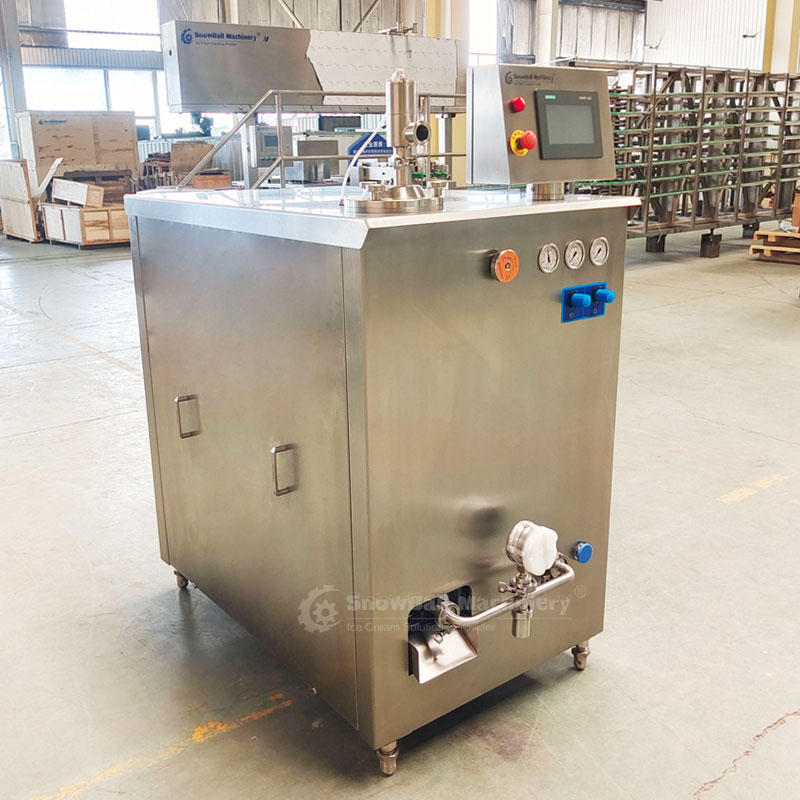 The continuous freezer sets the hourly output ceiling that every other unit on an ice cream line has to match.
The continuous freezer is the throughput reference point of an industrial ice cream line. It decides how many litres of frozen product leave the machine per hour, and the pasteurizer, homogenizer, ageing tank, ingredient feeder, filling machine and hardening tunnel are all sized around that single number. A freezer that is too small caps peak-season sales; a freezer that is too large runs inefficiently on short batches. Both mistakes are made on paper, long before the machine is delivered.
This guide is written for buyers at the research and evaluation stage. It explains how to specify an industrial ice cream continuous freezer using the SNCF series from Snowball Machinery as a working reference: five model designations — SNCF 50L, SNCF 300L, SNCF 600L, SNCF 1200L and SNCF 1500L — covering a rated capacity range from 50 L/h to 1500 L/h, with 100% overrun, a +5 °C input material temperature, a −5 °C output material temperature, food-grade SS304 / SS316 stainless steel construction, and a defined set of internationally branded components including SIEMENS, Schneider Electric, FESTO, SMC, Danfoss, ABB, Bonfiglioli, igus, Copeland, Bitzer and SEW Eurodrive.
Problem Definition: Where Continuous Freezer Specifications Go Wrong
Most specification errors are not engineering errors. They are documentation errors that only become visible when the line is running. The recurring failure patterns are consistent:
- Capacity quoted without a defined unit. "300 litres per hour" is meaningless until the buyer and the supplier agree whether the figure refers to mix intake or to frozen product output. Because overrun changes the relationship between the two, an unconfirmed unit can produce a line that is short by a large margin at the filling machine.
- Overrun treated as a footnote. Air incorporation is not a detail of taste; it is a multiplier on volume. A specification that fixes capacity but leaves overrun undefined leaves the actual sellable output undefined as well.
- Input temperature assumed rather than engineered. The SNCF platform is rated for a +5 °C input material temperature. If the upstream ageing tank or premix system does not deliver mix at that condition, the freezer cannot be expected to hold its rated output.
- Material grade chosen by price alone. SS304 and SS316 are both accepted for food contact, but they behave differently under aggressive cleaning regimes and different regulatory expectations. The grade should follow the product, the CIP programme and the destination market.
- Components promised but not locked. A component brand list is a contractual specification. If it is not attached to the order and verified at the factory acceptance stage, substitution becomes a commercial argument rather than an engineering decision.
- Certification scope assumed from the brand name. A CE certificate is issued against a defined machine type and standard set, not against a company in general. The certificate has to name the equipment that is actually shipped.
- No expansion path. Freezer capacity is usually the first constraint a growing ice cream factory hits, and the cheapest way to hit it is to have planned for it.
Industry Background: Why Freezer Capacity Decisions Are Being Revisited
Hard ice cream processing equipment accounted for a dominant 57.8% share of the total ice cream equipment market in 2025, with continuous freezers being the leading product type in that segment (Future Market Insights, 2025). The global ice cream processing equipment market was valued at approximately USD 2.33 billion in 2025 and is projected to reach USD 3.00 billion by 2034, a CAGR of 2.71% (IMARC Group).
That growth profile matters for specification. A market expanding at a low single-digit rate is not driven mainly by brand-new greenfield capacity; it is driven by replacement, automation upgrades and line expansion at existing producers. Those are exactly the projects in which a freezer is re-specified — and in which an incorrect capacity or an undocumented component list creates problems that persist for the service life of the machine.
The regulatory frame is equally concrete. Commercial ice cream appliances and ice-makers are regulated under the safety standard IEC 60335-2-89:2019, which covers electrically operated refrigerating appliances with incorporated motor-compressors (IECEE / International Electrotechnical Commission). For machinery supplied into European and other export markets, the assessment route typically runs through EN ISO 12100:2010 for risk assessment and risk reduction and EN 60204-1:2018 for the electrical equipment of machines. These are the standard references that appear on the certificates issued for the SNCF continuous freezer and for the other units in a Snowball Machinery line.
The SNCF Continuous Freezer: What a Complete Specification Contains
The SNCF series is the continuous freezer platform manufactured by Snowball Machinery Manufacturing Co., Ltd, an ice cream equipment manufacturer that integrates R&D, manufacture, assembly, commissioning, export and after-sales service, and that exports the majority of its output to North America, South America, Europe, Asia and Africa. The verified specification parameters of the platform are as follows:
- Model designations: SNCF 50L, SNCF 300L, SNCF 600L, SNCF 1200L, SNCF 1500L
- Capacity: 50–1500 L/H across the series
- Overrun: 100%
- Temperature of input material: +5 °C
- Temperature of output material: −5 °C
- Application: ice cream production
- Material: high quality food grade stainless steel SS304 / SS316
- Main component brands: SIEMENS, Schneider Electric, FESTO, SMC, Danfoss, ABB, Bonfiglioli, igus, Copeland, Bitzer, SEW Eurodrive
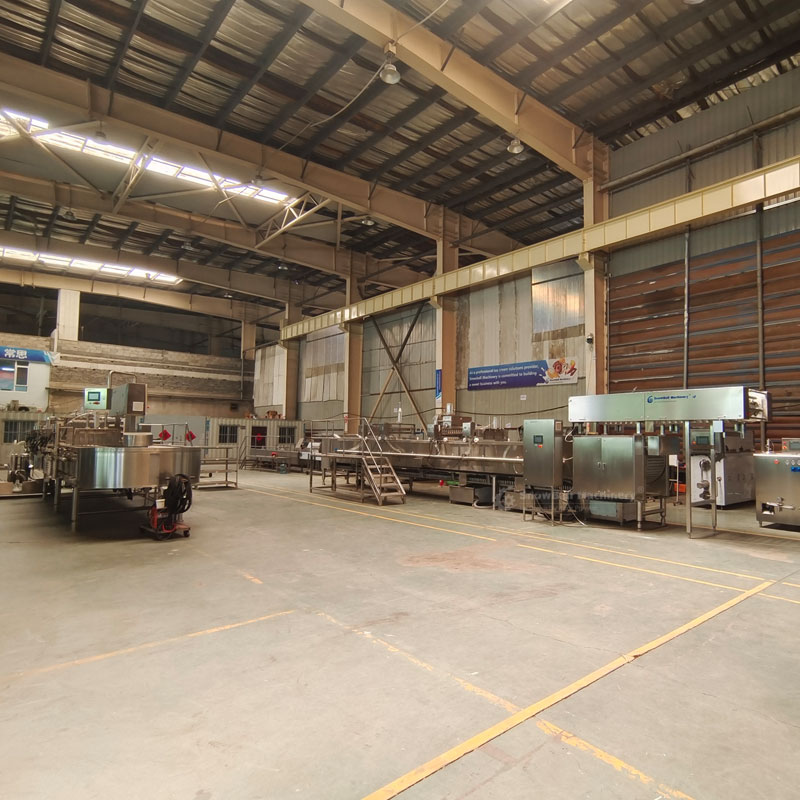 Assembly workshop: the component specification agreed at quotation stage is verified on the machine before shipment.
Why the component list is a specification, not a slogan
The named brands belong to a defined set of suppliers used across the SNCF freezer and the wider Snowball Machinery range. For a buyer, the practical value of that list is not prestige; it is serviceability. A continuous freezer is a machine that runs continuously through a season, and its critical spares should be available from suppliers with global distribution rather than from a single source. The evaluation questions that follow from this are concrete: Is the component list attached to the technical agreement? Can it be checked against the delivered machine? How long is the spare parts supply commitment, and how quickly can a replacement part be shipped?
Snowball Machinery's stated after-sales scope covers on-site installation and commissioning, equipment upgrading, equipment maintenance, fault handling, spare parts supply, regular inspection and timely global response — which is the operational side of the same question.
Certification as a constraint parameter, not an afterthought
A freezer sized correctly but certified incompletely is still a specification failure. The SNCF continuous freezer holds CE certification number CE-4681-181125, issued by European Certification Services. The certification applies to the global market, is based on the standards EN ISO 12100:2010 and EN 60204-1:2018 +A1:2025, and covers the machine scope "Ice Cream Continue Freezer".
The rest of a typical line carries its own documentation. The molded stick ice cream machine (SNL) holds CE certification FQC2506302 issued by FQC STANDARD against EN ISO 12100:2010 and EN 60204-1:2018, and CE certification CE-1654-01-111123 issued by CGS Test against BS EN ISO 12100:2010 and BS EN 60204-1:2018. The ingredient feeder (SNFF1000 / SNFF2000 / SNFF4000) holds CE certification CE-1724-01-121223 issued by CGS Test against BS EN ISO 12100:2010 and BS EN 60204-1:2018. All of these apply to the global market.
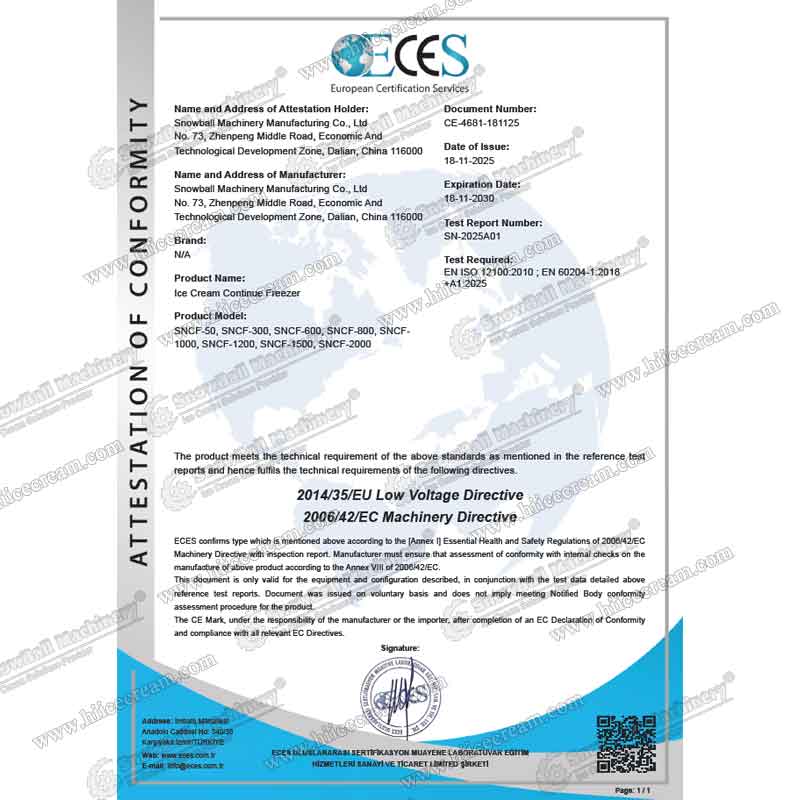 The CE certificate must name the machine type that is actually shipped — here, the ice cream continuous freezer.
Step-by-Step Breakdown: Seven Decisions in the Specification Sequence
Step 1 — Fix the product and the hourly output target
Start from the market side: which products, in which formats, at what hourly piece rate, in which season. A line that runs cups and cones at high piece rates, and a line that runs extruded bars in a short summer window, will land on very different freezer capacities even if their annual tonnage is identical. The SNCF platform serves ice cream production across large-scale, medium-scale and small-scale factories, ice cream plants, chain-restaurant ice cream factories, creative ice cream factories, workshops and factory laboratory R&D.
Step 2 — Convert product output into freezer capacity, and resolve the unit question
Convert your piece rate into litres per hour of frozen product, then confirm in writing whether the quoted L/H figure refers to mix intake or frozen output. The SNCF series states a rated capacity of 50–1500 L/H with 100% overrun. Overrun describes how much air is incorporated: at 100% overrun the frozen product contains a substantial volume of air, so the relationship between mix consumption and finished volume is a direct multiplier. Confirming the unit convention is the single highest-value question a buyer can ask at this stage.
Step 3 — Check the thermal chain from +5 °C
The SNCF freezer is rated for a +5 °C input material temperature and a −5 °C output material temperature. That defines the interface with the upstream process: premix preparation, HTST pasteurization or batch pasteurization, homogenization, and ageing must deliver mix at the specified inlet condition and at a rate that matches the freezer. A Snowball Machinery line typically pairs the freezer with an SNFF ingredient feeder (customizable from 50 to 4000 litres/hour), a fruit feeder or ripple pump, and the downstream filling, moulding or extrusion equipment.
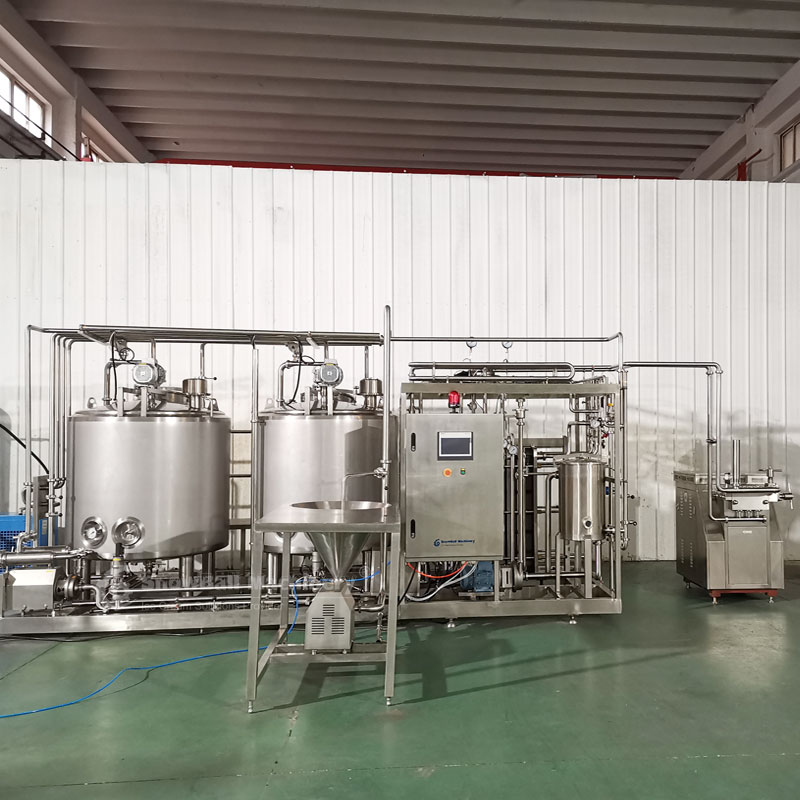 Upstream condition matters: the freezer rating assumes mix arriving at the specified inlet temperature.
Step 4 — Choose the construction material deliberately
SS304 and SS316 are both offered on the SNCF platform. The choice should follow the product acidity, the cleaning chemicals and the destination market's expectations, not the price difference alone. Two documented project references illustrate how the decision is made in practice: a North American factory upgrade used food grade 316 stainless steel throughout to satisfy local production compliance requirements, while a European ice cream manufacturer's sandwich line was built in food grade 304 stainless steel to meet EU food safety and environmental standards.
Step 5 — Lock the component specification
Write the component brand set into the technical agreement: SIEMENS, Schneider Electric, FESTO, SMC, Danfoss, ABB, Bonfiglioli, igus, Copeland, Bitzer, SEW Eurodrive. Then add the verification clause — the component list is checked against the machine before shipment, and the check is documented. This converts a marketing statement into a procurement control.
Step 6 — Confirm certification scope, not just certification presence
Match three things: the certificate number, the machine type in the certificate scope, and the machine you are buying. For the SNCF freezer the reference is CE-4681-181125 from European Certification Services, against EN ISO 12100:2010 and EN 60204-1:2018 +A1:2025. Confirm the certificate's validity period, and confirm that the surrounding standard framework for your market — including IEC 60335-2-89:2019 where it applies — has been addressed in the technical file.
Step 7 — Plan the expansion path and the acceptance test
Ask two forward-looking questions before signing. First, how will capacity be added if demand grows — by adding a second freezer, or by reconfiguring the line? Snowball Machinery builds non-standard customized equipment, and modular line design has been used in project references to allow straightforward capacity expansion. Second, what does acceptance look like: Snowball Machinery applies full-process control from material selection to production and 100% testing before shipment, which gives the buyer a defined verification point before the machine leaves the factory.
Use Cases: Matching SNCF Capacity to Production Scale
The five SNCF designations exist because ice cream factories do not share a single production logic. The pairing below is a planning aid based on rated capacity; final selection is confirmed against your product mix and line balance.
- SNCF 50L (50 L/H class): trial production, factory laboratory R&D, small-capacity lines for new product development, and workshops testing new recipes before committing to a full line. Small-scale factories and small dairy plants have also used low-capacity configurations for limited product ranges.
- SNCF 300L (300 L/H class): small-scale ice cream factories, small cold drink processing plants, and start-up producers moving from manual or semi-automatic operation to continuous production.
- SNCF 600L (600 L/H class): medium-scale factories running multi-flavour or multi-format portfolios where the freezer has to switch between products without losing output stability.
- SNCF 1200L (1200 L/H class): medium-to-large factories with peak-season load profiles, distributor supply obligations and supermarket order cycles.
- SNCF 1500L (1500 L/H class): large-scale factories and central production sites running 24-hour continuous operation, typically feeding stick lines, cone filling lines or extrusion and hardening tunnels.
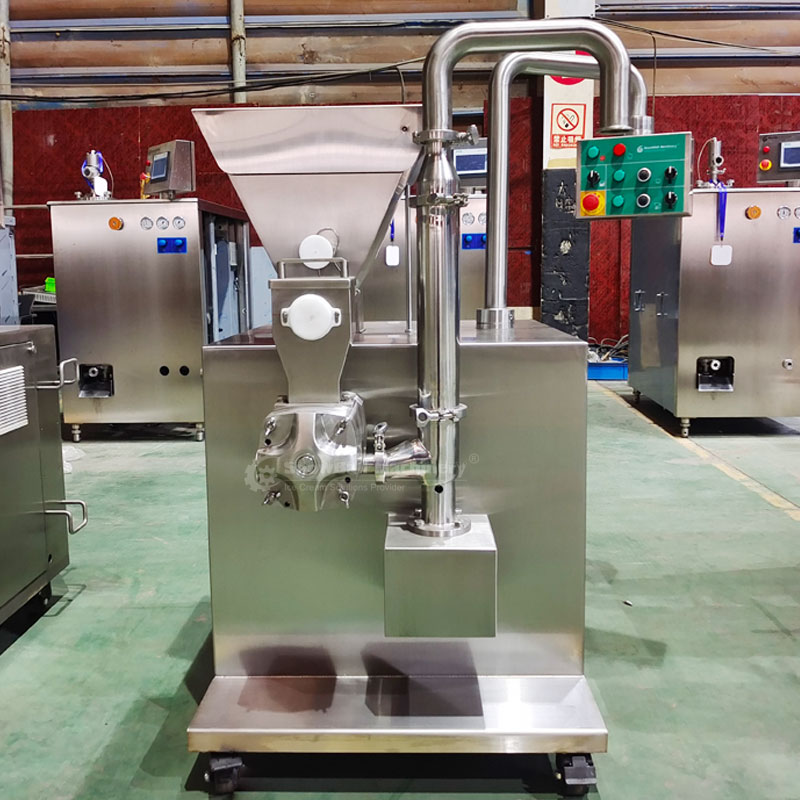 Downstream units such as the SNFF ingredient feeder are matched to the freezer's rated throughput, not chosen independently.
Three project references show how capacity decisions are validated in operation. A newly established ice cream manufacturer supplying supermarket and retail channels installed a complete line with continuous ice cream freezers, extrusion tunnel and packing machines at an output of 9,000–10,000 pieces per hour; the equipment has maintained stable operation for three years in high-temperature and high-humidity conditions, and the modular design allows straightforward capacity expansion. A world-renowned brand ice cream factory runs an automatic cone filling line at 10,000–15,000 pieces per hour and a stick ice cream production line at 15,000–20,000 pieces per hour, operating stably for 12 years. A start-up client that entered the market with no prior ice cream production experience commissioned an extruded magnum ice cream tunnel at 5,000–8,000 pieces per hour together with a 1200 L/H family pack filling machine, and has run stably for 11 years.
A fourth reference shows why material and component specification matter as much as capacity: a long-established ice cream manufacturer upgrading equipment that had been in service for 40 years used custom-designed workstations in food grade 316 stainless steel that matched the existing line, achieving a 40% increase in production efficiency and a 70% reduction in upgrading cost, with six years of stable operation since.
Comparison Table: SNCF Series Specification Matrix
The matrix below sets out the shared specification parameters of the SNCF continuous freezer range against the five model designations.
| Parameter | SNCF 50L | SNCF 300L | SNCF 600L | SNCF 1200L | SNCF 1500L |
|---|---|---|---|---|---|
| Rated capacity | 50 L/H class | 300 L/H class | 600 L/H class | 1200 L/H class | 1500 L/H class |
| Series capacity range | 50–1500 L/H across the SNCF series | ||||
| Overrun | 100% | ||||
| Input material temperature | +5 °C | ||||
| Output material temperature | −5 °C | ||||
| Construction material | High quality food grade stainless steel SS304 / SS316 | ||||
| Main component brands | SIEMENS, Schneider Electric, FESTO, SMC, Danfoss, ABB, Bonfiglioli, igus, Copeland, Bitzer, SEW Eurodrive | ||||
| CE certification | CE-4681-181125, European Certification Services; EN ISO 12100:2010, EN 60204-1:2018 +A1:2025; global market | ||||
| Application | Ice cream production, in large-scale, medium-scale and small-scale ice cream factories, ice cream plants, chain-restaurant ice cream factories, creative ice cream factories, workshops and factory laboratory R&D | ||||
Capacity designations, overrun, temperature ratings, material and certification data as stated for the SNCF continuous freezer platform.
A second, equally useful table is the verification checklist. It is not a comparison of suppliers; it is a comparison of what you asked for against what you can prove.
| Verification item | What to request | Why it matters |
|---|---|---|
| Capacity unit convention | Written definition of whether L/H refers to mix intake or frozen output | Determines the real hourly output of the whole line |
| Overrun | Stated overrun value and its effect on volume | Affects product texture, portion cost and filling throughput |
| Thermal interface | Confirmation that upstream equipment delivers mix at the specified inlet temperature | Rated output depends on the inlet condition |
| Material grade | SS304 or SS316 confirmed against product and cleaning regime | Corrosion resistance and market compliance |
| Component list | Brand list attached to the technical agreement and checked before shipment | Prevents undocumented substitution and protects spares supply |
| Certification scope | Certificate number, issuing body, standards, machine type and validity | A certificate for a different machine type does not cover your freezer |
| Testing record | Evidence of full-process control and 100% testing before shipment | Gives a defined verification point before delivery |
| Expansion path | Documented options for increasing capacity later | Avoids rebuilding the line at the next growth step |
FAQ: Specifying an Ice Cream Continuous Freezer
What certification should an ice cream continuous freezer carry for export markets?
The SNCF continuous freezer holds CE certification number CE-4681-181125, issued by European Certification Services. It applies to the global market and is based on EN ISO 12100:2010 and EN 60204-1:2018 +A1:2025, with the certificate scope naming the ice cream continuous freezer. Buyers should verify three things: that the certificate number can be checked with the issuing body, that the machine type in the scope matches the equipment being purchased, and that the certificate is still within its validity period. Where commercial ice cream appliances and ice-makers fall under IEC 60335-2-89:2019, that standard should also be addressed in the supplier's technical documentation.
Can one continuous freezer run several product types, and can capacity be expanded later?
The SNCF platform is part of a non-standard customized equipment programme: equipment is configured according to product design and hourly production capacity, and the series itself spans five designations from the 50 L/H class to the 1500 L/H class. In practice this means a single freezer configuration can be specified around a defined product portfolio, and the surrounding units — ingredient feeder, fruit feeder, ripple pump, filling machine, moulding or extrusion line — are matched to it. Expansion is normally planned at the line level rather than the freezer level; a documented project reference used a modular design specifically so that capacity could be added without replacing the original equipment.
What drives the cost of a continuous freezer specification?
Because the SNCF range and the surrounding line are built as non-standard customized equipment, cost is a function of configuration rather than a list price. The main cost drivers are the capacity designation selected, the stainless steel grade (SS304 or SS316), the specified component brand set, the degree of automation and integration required, the certification and documentation scope for the destination market, and the number of units in the line. Minimum order quantity for the equipment programme is 1 set, and monthly production capacity is 100 sets, so a single-machine project and a full-line project follow the same configuration logic. A configured quotation is therefore the only meaningful cost figure.
Can we validate the freezer and the line before committing to full production?
Yes. The equipment programme is built against customer production scale, product positioning, product design and workshop conditions, and Snowball Machinery jointly develops new ice cream products with ice cream factories — which means the configuration can be validated against a real product rather than a generic specification. Every machine undergoes full-process control from material selection to production and 100% testing before shipment, in line with food safety production standards. For buyers with no prior ice cream production experience, a turnkey whole-plant approach covering plant layout planning, installation and commissioning has been used to take projects from zero experience to standardised production.
What is the lead time, and what happens after delivery?
Lead time is determined by the specific equipment plan, so it is confirmed together with the configuration rather than quoted independently of it. After delivery, the stated after-sales scope covers on-site installation and commissioning, equipment upgrading, equipment maintenance, fault handling, spare parts supply, regular inspection and timely global response. As a next step, you can download the full product and specification brochure at Snowball Machinery brochure, or send your product design and target hourly output to ice@snowballmachinery.com and the capacity case can be worked through with your own numbers.
Conclusion
Specifying an industrial ice cream continuous freezer is a sequence, not a selection. Define the product and hourly output, resolve whether the capacity figure refers to mix or frozen product, verify the +5 °C inlet condition against the upstream process, choose SS304 or SS316 deliberately, lock the component brand list including SIEMENS, Schneider Electric, FESTO, SMC, Danfoss, ABB, Bonfiglioli, igus, Copeland, Bitzer and SEW Eurodrive, and confirm that the CE certification — CE-4681-181125 for the ice cream continuous freezer — actually covers the machine type you are buying. Capacity across the SNCF series runs from 50 L/h to 1500 L/h, which means the specification decision is not about finding a freezer that can do the job, but about proving on paper which one does it at your throughput.
Next Step: Turn Your Product Data into a Freezer Specification
Snowball Machinery Manufacturing Co., Ltd builds complete industrial ice cream machine systems — premix and pasteurization, ageing, continuous freezing, ingredient feeding, filling, moulding, extrusion and packaging — as turnkey lines configured to your production scale.
Download the product brochure: Ice cream machine catalogue and specifications (PDF)
Send your requirement: ice@snowballmachinery.com | ice@hiicecream.com
Website: icecreammachinemanufacturer.com

Have Questions or Need More Details?
Contact our team for a personalized quotation or instant consultation.
Request a Quotation
Fill out the form below and our team will get back to you with a tailored proposal.

LINE Direct Chat
Prefer to chat in real-time? Message us on LINE for instant assistance & quick answers.
- Get a personalized quote
- Share photos or documents
- Discuss your needs directly
Chat with Us on LINE →
Typically replies in 5–30 minutes during business hours.