Molded Stick vs. Extrusion & Hardening Ice Cream Lines: A Head-to-Head Decision Guide
Molded Stick vs. Extrusion & Hardening Ice Cream Lines: A Head-to-Head Decision Guide
Choosing between a molded stick line and an extrusion and hardening line is not a brand comparison. It is a factory-planning decision that is settled by three things, in this order: the product formats you must ship, how the line has to integrate with the rest of your plant, and which optional units and spare parts you need in order to keep that format range alive for the next five years. Product format decides the forming principle. Integration decides the surrounding equipment. Optional units decide your real changeover cost.
This guide compares the SNL molded stick ice cream machine with the SNEX ice cream extrusion and hardening line from Snowball Machinery Manufacturing Co., Ltd, an ice cream equipment manufacturer founded in 2020, operating a 4,000 m² factory with 50 employees, 10 engineers and an annual output of 1,200 sets, exporting to North America, South America, Europe, Asia and Africa. Both lines are non-standard, capacity-customized equipment built on the same upstream platform, which is exactly why buyers so often compare them against each other and then struggle to separate them.
Problem Definition: Two Lines That Both Look Like "Stick" Production
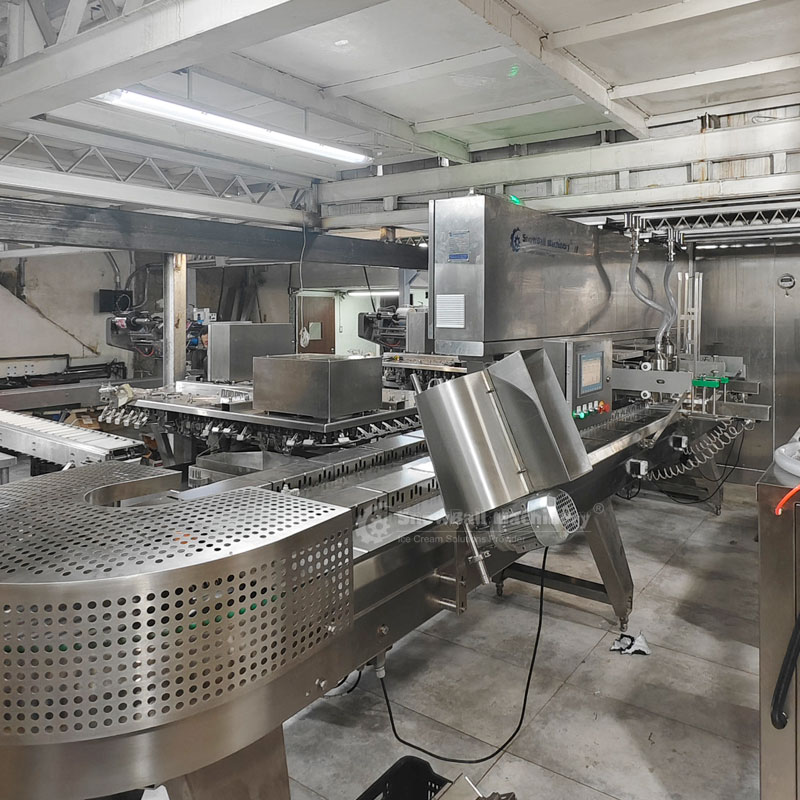
The confusion is understandable. The SNL family covers molded stick ice cream, popsicle, ice lolly, frozen novelties, fruit bars and water ice. The SNEX family lists stick ice cream among its supported formats as well, alongside cake ice cream, sandwich ice cream, wave ice cream, extruded ice cream, ice cream ball cone, bonbon ice cream, ice cream choco bar, Eskimo bars, magnum ice cream, funny face ice cream and log ice cream. On paper, both lines can put a stick in a box.
The operational difference is the forming principle. In a molded line, the mix is dosed into a mould, the stick is inserted, and the product takes its shape from the cavity of the mould. In an extrusion line, the ice cream is extruded and cut to profile, then passed through a hardening tunnel to set. The mould defines the shape on one line; the die and the cut define it on the other.
That single difference cascades into every downstream planning question a buyer faces: how many shape variants you can run without new tooling, how much of the line is dedicated to stick handling, how much space the hardening stage consumes, and how the line behaves when marketing asks for a new format six months after commissioning.
Decision rule: if the SKU plan is dominated by classic moulded sticks, water ice and fruit bars, evaluate SNL first. If the plan is dominated by extruded profiles, sandwiches, cakes, waves, logs or chocolate-coated bars, evaluate SNEX first. If both appear in the plan, plan two lines on shared upstream equipment rather than one line attempting both.
Industry Background: Why Both Forming Routes Now Sit Side by Side
The industrial ice cream equipment market is large enough to support specialist line types rather than one universal machine. Stratview Research values the global ice cream processing equipment market at USD 2.4 billion in 2025. Within that market, continuous freezers represent approximately 29.4% of the total equipment type segment, which reflects how central the freezing stage is to every line configuration, molded or extruded.
Demand is also geographically concentrated. IMARC Group reports North America holding a share of over 42.0% of the ice cream processing equipment market as of 2025, a region where multi-format portfolios and private-label novelty programmes are common. Broadly speaking, the commercial pressure that pushes factories toward both forming routes is product proliferation: retailers ask for more shapes, more coatings, more pack formats, and factories respond by adding capability rather than replacing it.
What aggregate market data cannot tell a buyer is which line to install on a specific factory floor. That question is answered at the level of product design, hourly capacity and workshop conditions, which is precisely the basis on which Snowball Machinery states it customizes production line solutions.
Detailed Solution: What the SNL Molded Stick Line Actually Covers
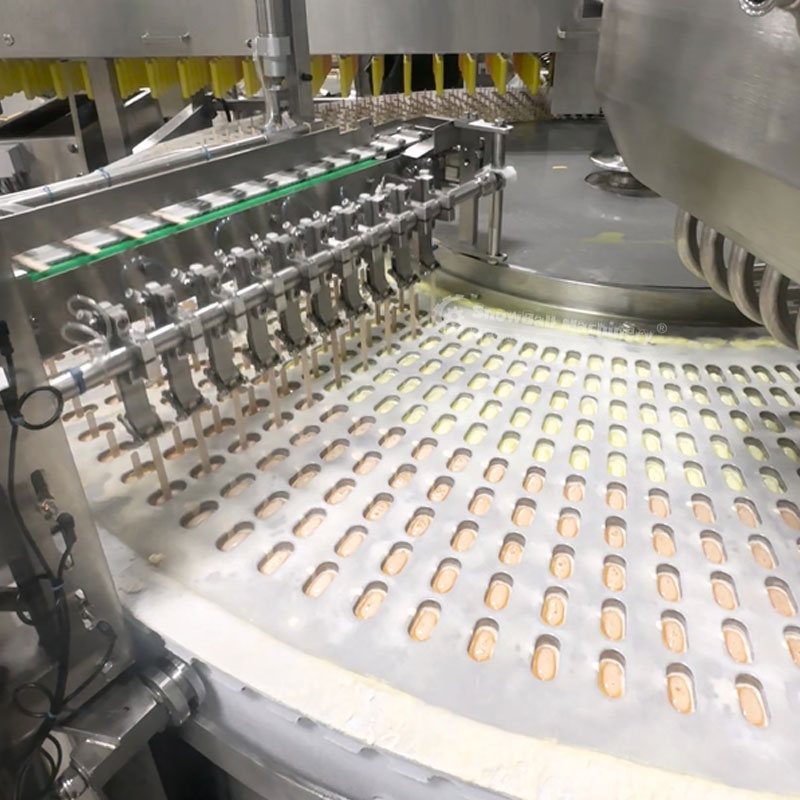
The SNL is not a single machine but a configuration family. Snowball Machinery lists it as a molded stick ice cream machine covering the manual ice lolly machine, semi-auto stick ice cream machine, linear stick ice cream machine, inline popsicle machine, oval type stick ice cream machine, rotary moulded stick ice cream machine and popsicle parallel line.
That range matters at the evaluation stage because it means the forming principle stays constant while automation level changes. A buyer entering the market can start closer to the manual or semi-automatic end; a buyer running high-volume novelty production can move to the rotary moulded or parallel line configuration. The product scope stays the same across the family: molded stick ice cream, moulded sticks ice cream, popsicle, ice lolly, frozen novelties, fruit bars and water ice.
Build specification common to the SNL family
- Material: high quality food grade stainless steel SS304 / SS316.
- Capacity: can be customized according to needs.
- Equipment type: non-standard customized complete ice cream production equipment, customized on the basis of product design and hourly production capacity.
- Main components: SIEMENS, Schneider Electric, FESTO, SMC, Danfoss, ABB, Bonfiglioli, igus, Copeland, Bitzer and SEW Eurodrive.
- Scope of supply model: turnkey, covering factory design and a full line of ice cream machines from A to Z.
The practical consequence of the customization basis is that capacity is not selected from a fixed catalogue. It is derived from two inputs the buyer already controls: the product design (shape, size, stick type, coating) and the hourly output the business plan requires.
Detailed Solution: What the SNEX Extrusion & Hardening Line Actually Covers
The SNEX is designed for ice cream plants rather than for a single novelty format. Its supported product list is broad: ice bar, funny face ice cream, log ice cream, cake ice cream, sandwich ice cream, wave ice cream, extruded ice cream, ice cream ball cone, bonbon ice cream, ice cream choco bar, Eskimo bars, magnum ice cream and stick ice cream.
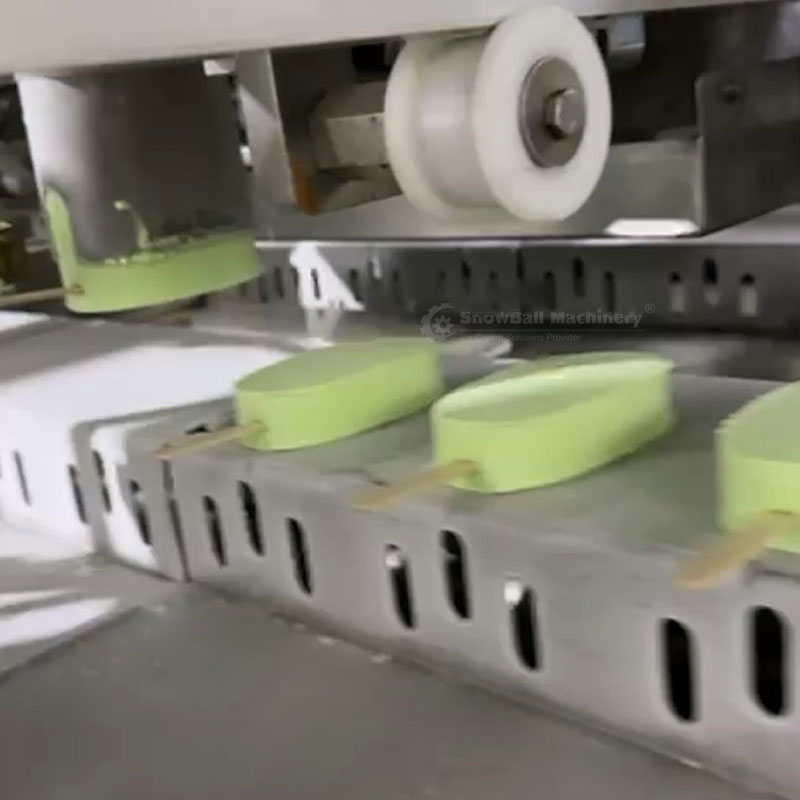
Where the molded line is organized around moulds, the extrusion line is organized around a forming head, a cutting arrangement and a hardening tunnel. That structure is what makes formats such as sandwich, cake, wave and log practical: the product is built up as a continuous profile and then portioned, rather than poured into a cavity.
Build specification common to the SNEX line
- Material: high quality food grade stainless steel SS304 / SS316.
- Capacity: can be customized according to needs.
- Equipment type: non-standard customized complete ice cream production equipment, customized on the basis of product design and hourly production capacity.
- Main components: the same internationally renowned brand set as the SNL family.
- Scope of supply model: turnkey, covering factory design and a full line from A to Z.
One planning point is easily missed: on an extrusion line, the hardening stage is not an accessory. The tunnel is part of the forming system, because the profile must set before it can be packed without deformation. Buyers comparing quotations should therefore check whether the hardening tunnel is inside the quoted scope, and how it is matched to the upstream freezer.
Where Both Lines Share the Same Platform
Because both lines come from the same manufacturer, the upstream and downstream equipment is largely interchangeable. That is a genuine planning advantage when a factory eventually runs both formats.
Snowball Machinery lists premix machines, HTST systems, batch pasteurizing systems, ageing tanks, CIP systems, continuous freezers, fruit feeder systems, moulding machines, filling machines, hardening tunnels, extrusion machines, robotic machines, sandwich machines, cake machines, packing machines and cartoning machines. In process terms, that means both SNL and SNEX can sit behind the same mix preparation and freezing block, and in front of the same packing block.
The SNCF continuous freezer as the common reference point
The SNCF series is quoted at 50–1500 L/H, with 100% overrun, input material at +5 °C and output material at −5 °C, and is supplied in 50L, 300L, 600L, 1200L and 1500L models. Because the freezer capacity is the throughput anchor for both line types, it is the correct first specification to fix before comparing SNL and SNEX configurations.
The SNFF ingredient feeder as the second common unit
The SNFF ingredient feeder is offered in SNFF1000, SNFF2000 and SNFF4000 models with capacity customizable from 50 litres to 4,000 litres per hour. Inclusion capability affects both lines: fruit, nuts, cookie pieces and similar additions are dosed before forming, whichever forming principle is used.
Step-by-Step: How to Decide Between SNL and SNEX
- Write the SKU list before the specification. List every product you intend to sell in the first 24 months, with shape, stick or no stick, coating and pack format. This is the input that determines the forming principle, and it is also the input Snowball Machinery states it customizes against.
- Fix the hourly capacity target. Both lines are customized on the basis of product design and hourly production capacity, so capacity is an input rather than an output. Set the number from the sales plan, not from the machine catalogue.
- Size the freezer first. Select an SNCF model between 50 L/H and 1500 L/H that matches the target, and confirm overrun and in/out temperatures for your recipe.
- Decide the automation level on the molded side, or the format range on the extruded side. If you choose SNL, the real decision is manual, semi-auto, linear, inline, oval type, rotary moulded or parallel line configuration. If you choose SNEX, the real decision is which profiles and combinations the line must produce.
- Price the optional units into the first quotation, not the third. For molded stick production, the SNLU option set covers the ice water filler, ice cream sucker unit, ice cream stick inserter unit, chocolate coating station, dry coating station and popsicle ice cream moulds. Leaving coating or stick insertion out of round one usually means re-quoting the line later.
- Plan changeover and spare parts. Moulds, stick inserter components and coating stations are wear-and-format items. Agree the spare parts list and the mould set at order stage, and confirm the mould change procedure with the supplier's commissioning engineers.
- Match the line to the building. Workshop conditions are one of the stated customization inputs. Confirm floor loading, ceiling height for the hardening tunnel, utilities, and the drainage and CIP routing before signing, not after the equipment arrives.
- Agree acceptance and handover. Confirm pre-shipment testing, on-site inspection and third-party inspection arrangements, plus installation and commissioning support, before the payment schedule is finalized.
Use Cases: Which Format Wins in Which Scenario
Water ice, fruit bars and classic popsicles. These are molded formats. The mould defines the shape and the ice water filler unit is part of the SNL option set precisely because water ice production has its own dosing requirements. An extrusion line is not the natural fit for a simple water ice stick.
Chocolate-coated stick bars. Both routes can reach the market, but the coating decision is separate from the forming decision. A molded line with a chocolate coating station and a dry coating station produces a coated molded stick. An extrusion line produces a coated extruded bar. The choice should follow the shape and texture target, not the coating alone.
Sandwich, cake, wave and log formats. These are extrusion formats. A European ice cream manufacturer running an ice cream sandwich line reported rapid installation, commissioning and production launch, with newly launched products quickly gaining market recognition, and the line has been operating stably for 5 years.
Start-up factories with no production history. One start-up client with no prior ice cream production experience received a turnkey whole-plant solution including an extruded ice cream tunnel machine rated 5,000–8,000 pcs/h and a family pack ice cream filling machine at 1,200 L/H. That project has run stably for 11 years with continuous after-sales service and no major failures.
Existing plants upgrading an old line. A long established manufacturer replacing equipment that had been in service for 40 years chose custom-designed workstations that matched the original production line without overall reconstruction, built in food grade 316 stainless steel. Reported results were a 40% increase in production efficiency, a 30% reduction in labour cost and a 70% cut in equipment upgrading cost, with the line running stably for 6 years.
High-volume branded production. A world renowned brand ice cream factory operates an automatic cone ice cream filling line at 10,000–15,000 pcs/h and a stick ice cream production line at 15,000–20,000 pcs/h across Venezuela, Kuwait, Turkey, Sri Lanka and Indonesia, achieving 24-hour fully automatic production and 12 years of stable operation.
Head-to-Head Comparison Table
The table below compares only characteristics that are documented for each line. It is a configuration reference, not a ranking: the right line is the one that matches the SKU list.
| Decision dimension | SNL molded stick line | SNEX extrusion & hardening line |
|---|---|---|
| Forming principle | Product shape defined by the mould cavity; stick inserted at a dedicated station | Product profile extruded and cut, then set in a hardening tunnel |
| Documented product formats | Molded stick ice cream, moulded sticks ice cream, popsicle, ice lolly, frozen novelties, fruit bars, water ice | Ice bar, funny face ice cream, log ice cream, cake ice cream, sandwich ice cream, wave ice cream, extruded ice cream, ice cream ball cone, bonbon ice cream, ice cream choco bar, Eskimo bars, magnum ice cream, stick ice cream |
| Configuration variants listed | Manual ice lolly machine, semi-auto, linear, inline popsicle, oval type, rotary moulded, popsicle parallel line | Line configured by product design and hourly capacity (non-standard customization) |
| Capacity | Customized according to needs | Customized according to needs |
| Optional units and spare parts | SNLU range: ice water filler, ice cream sucker unit, stick inserter unit, chocolate coating station, dry coating station, popsicle ice cream moulds | Hardening tunnel plus associated SNB packing, cartoning and cold storage equipment; extrusion tooling set by product design |
| Material | Food grade stainless steel SS304 / SS316 | Food grade stainless steel SS304 / SS316 |
| Main components | SIEMENS, Schneider Electric, FESTO, SMC, Danfoss, ABB, Bonfiglioli, igus, Copeland, Bitzer, SEW Eurodrive | Same brand set |
| CE certificates naming this machine in the current set | FQC2506302 (rotary moulded stick, FQC STANDARD, to 2030-02-05); CE-1654-01-111123 (linear stick, CGS Test, to 2028-11-11) | Not named in this certificate set; the SNCF freezer (CE-4681-181125) and SNFF feeder (CE-1724-01-121223) carry their own certificates |
| Shared upstream platform | SNM premix, HTST, batch pasteurizing, ageing tank, CIP; SNCF freezer; SNFF feeder | Same upstream platform |
| MOQ | 1 set | 1 set |
| Lead time | According to the specific equipment plan | According to the specific equipment plan |
Optional Units, Spare Parts and Turnkey Integration
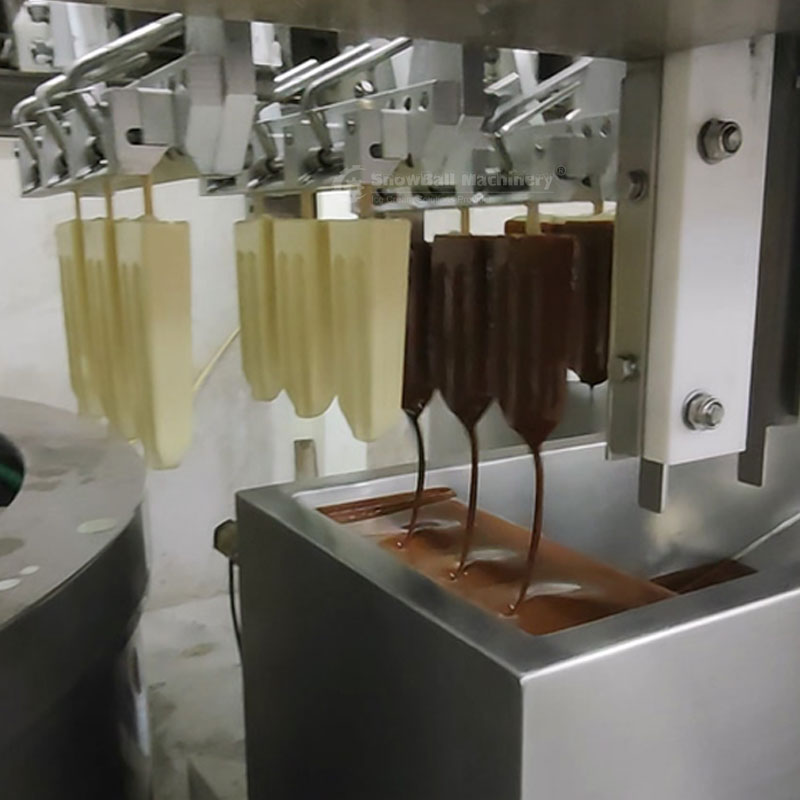
Optional units are where molded line budgets usually drift. The SNLU range turns a basic SNL line into a full novelty line: the ice water filler supports water ice production, the ice cream sucker unit and stick inserter unit handle stick placement, the chocolate coating station and dry coating station handle finishing, and the popsicle ice cream moulds define the shape catalogue. Each of these is also a changeover and spare-parts item, so the mould and station list should be agreed as part of the original order.
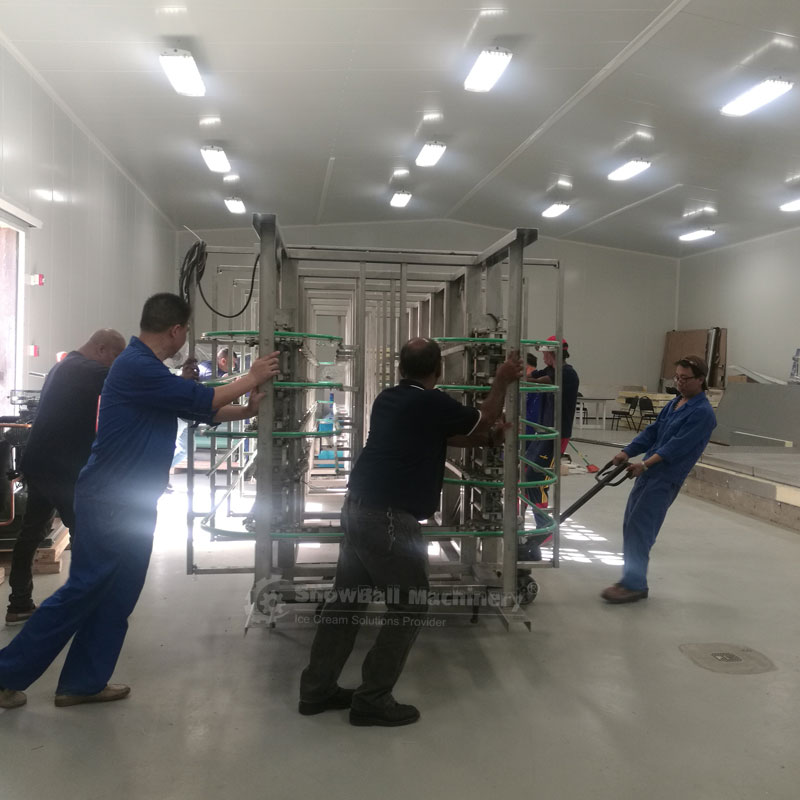
Turnkey support is the second integration layer. Snowball Machinery states that it designs the ice cream factory and provides a full line of ice cream machines from A to Z, and that it jointly develops new ice cream products with ice cream factories. For a buyer who has never commissioned a line, that combination matters more than a spec sheet: on one project, professional guidance helped the client master ice cream manufacturing processes quickly and reach standardized large-scale production, with factory construction and commissioning completed within a short period.
Service scope after handover is stated as on-site installation and commissioning, equipment upgrading, equipment maintenance, fault handling, spare parts supply and regular inspection, with timely global response. In one South America and Middle East project, 24/7 dedicated after-sales service with remote video support was provided to resolve operational issues promptly.
Frequently Asked Questions
1. Which CE certificates apply to the SNL molded stick line and to the SNEX extrusion line?
CE certification is issued against a defined machine scope, not against a product family name, so the correct check is certificate by certificate. Two certificates in the current document set name the SNL machine: certificate FQC2506302, issued by FQC STANDARD on 5 February 2025 and valid to 5 February 2030, covering the rotary moulded stick ice cream machine against EN ISO 12100:2010 and EN 60204-1:2018; and certificate CE-1654-01-111123, issued by CGS Test on 11 November 2023 and valid to 11 November 2028, covering the linear stick ice cream machine against BS EN ISO 12100:2010 and BS EN 60204-1:2018. The SNEX extrusion and hardening line is not named in these two documents. The machines that feed it carry their own: certificate CE-4681-181125 for the SNCF continuous freezer, issued by European Certification Services on 18 November 2025 and valid to 18 November 2030, and certificate CE-1724-01-121223 for the SNFF ingredient feeder, issued by CGS Test on 12 December 2023 and valid to 12 December 2028. Buyers should confirm that the certificate scope line matches the exact model being ordered.
2. Can one factory run molded stick and extrusion products on the same site?
Yes, and it is common practice, because both lines can share the same upstream block. The SNL family covers manual, semi-auto, linear, inline, oval type, rotary moulded and popsicle parallel line configurations for molded stick, popsicle, ice lolly, fruit bar and water ice production, while SNEX covers cake, sandwich, wave, extruded, log, bonbon, ball cone and magnum-style products. Because premix, HTST, batch pasteurizing, ageing, CIP, freezing and packing equipment are all listed in the same portfolio, a two-line factory can standardize utilities, spare parts and service. Where an existing line is being extended rather than replaced, custom-designed workstations can be built to match the original line without overall reconstruction, as in the 40-year-old line upgraded with 316 stainless steel workstations.
3. How should a buyer compare cost between the two lines?
Neither line has a list price, because both are non-standard and capacity-customized against product design and hourly output. The commercial framework is the same for both: MOQ 1 set; delivery terms FOB, CIF, EXW, CFR, DAP or DDP; payment of 50% T/T in advance with the remaining 50% before shipment; and acceptance based on pre-shipment testing, on-site customer inspection and third-party inspection such as SGS. The real cost drivers are the number of moulds and stations, the automation level on the molded side, the hardening tunnel rating on the extrusion side, and the optional units included in round one. As a reference point rather than a quotation, one complete line supplied to a newly established manufacturer in Jordan, Qatar, Venezuela, Chile and Peru came in at total line costs 70% lower than premium European brands while matching their quality and output performance.
4. How can we validate a product format before committing to a full line?
Validation starts with the product design and the hourly capacity target, because both lines are customized on exactly those two inputs, and the manufacturer states that it jointly develops new ice cream products with ice cream factories. On the molded side, format range is built from changeable items rather than from a new machine: popsicle ice cream moulds, the stick inserter unit, the ice water filler and the chocolate and dry coating stations are all listed as optional units and spare parts, so the shape catalogue can be expanded progressively. On the extrusion side, the profile tooling and the hardening tunnel are specified together with the product. The practical next step is a written configuration proposal against your own SKU list and output target, which you can request together with the product brochure at the Snowball Machinery catalogue.
5. What lead time and delivery capacity should be planned?
Lead time is quoted according to the specific equipment plan, which reflects the fact that both lines are configured per project rather than assembled from stock. Manufacturing capacity is stated at 100 sets per month, with an MOQ of 1 set, which gives an indication of scheduling headroom but does not replace a project-specific date. Buyers should also plan time for installation and commissioning, since after-sales scope includes on-site installation and commissioning, equipment upgrading, fault handling, spare parts supply and regular inspection. Where a factory must start production quickly, that handover stage is the part most often underestimated.
Planning a molded stick line, an extrusion line, or both?
Send your SKU list, hourly capacity target and workshop conditions to ice@snowballmachinery.com or ice@hiicecream.com. Snowball Machinery will return a configuration direction covering freezer sizing, forming principle, optional units and spare parts, and turnkey scope. The full equipment catalogue is available for download here.
Conclusion
The SNL molded stick line and the SNEX extrusion and hardening line do not compete for the same production brief. SNL is the mould-based route: seven configuration levels from manual ice lolly machine to popsicle parallel line, a defined option set in SNLU, and a product range built around molded stick ice cream, popsicle, ice lolly, fruit bars and water ice. SNEX is the profile-based route: extrusion, cutting and hardening, with a product range that reaches cake ice cream, sandwich ice cream, wave ice cream and extruded formats.
The decision sequence that holds up in practice is product format first, freezer capacity second, optional units third, and building integration fourth. Get the first two right and the quotation comparison becomes straightforward; get them wrong and no amount of supplier negotiation will fix the line afterwards.
Market reference data cited in this article: Stratview Research (ice cream processing equipment market, 2025), IMARC Group (regional market share, 2025). Machine specifications, certificates and case details are as documented by Snowball Machinery Manufacturing Co., Ltd.
Have Questions or Need More Details?
Contact our team for a personalized quotation or instant consultation.
Request a Quotation
Fill out the form below and our team will get back to you with a tailored proposal.

LINE Direct Chat
Prefer to chat in real-time? Message us on LINE for instant assistance & quick answers.
- Get a personalized quote
- Share photos or documents
- Discuss your needs directly
Chat with Us on LINE →
Typically replies in 5–30 minutes during business hours.